

In high-end industrial automation fields such as high-power converters, new energy grid connection, rail transit propulsion, and HVDC power transmission, high-speed closed-loop control and conventional process control have long faced industry pain points: two separate systems, double the cost, and complex coordination.
Traditional setups require a dedicated high-speed controller for power electronics control, plus an independent PLC to handle low-speed tasks such as cooling, monitoring, and interlocking. This not only increases hardware investment and cabinet space usage but also brings troubles like protocol conversion, timing synchronization, and complicated troubleshooting.
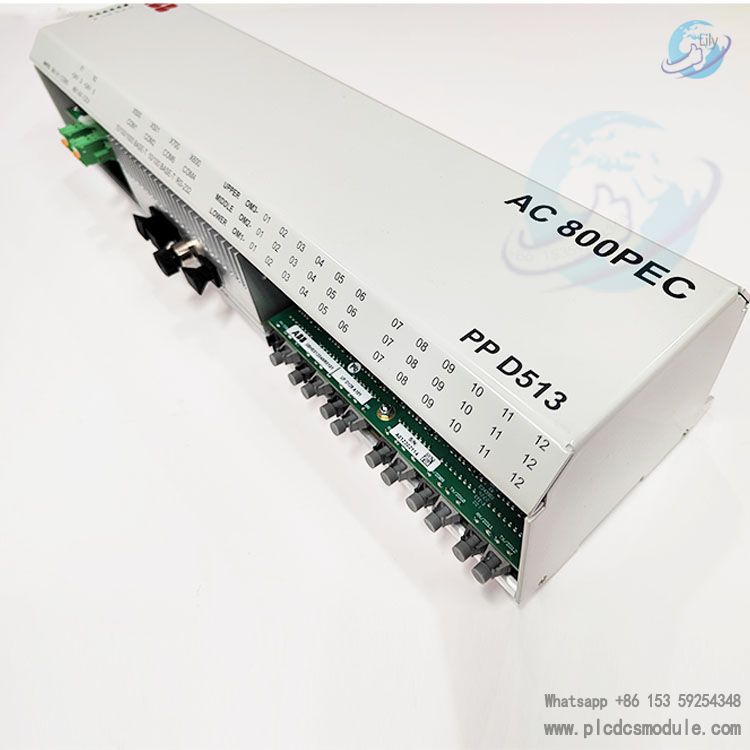
As a high-end modular high-speed controller in the ABB ControlIT series, ABB AC 800PEC pioneered the integration of microsecond-level high-speed power electronics control and millisecond-level conventional process control in one unit. It is perfectly suited for industrial environments with strong electromagnetic interference, high real-time requirements, and long-term stable operation, making it a benchmark solution for global power electronics and heavy-duty automation control.
This article provides an in-depth analysis from product positioning, hardware architecture, software system, communication capabilities, application scenarios, and model selection recommendations, offering a complete selection and application guide for engineers, purchasers, and system integrators.
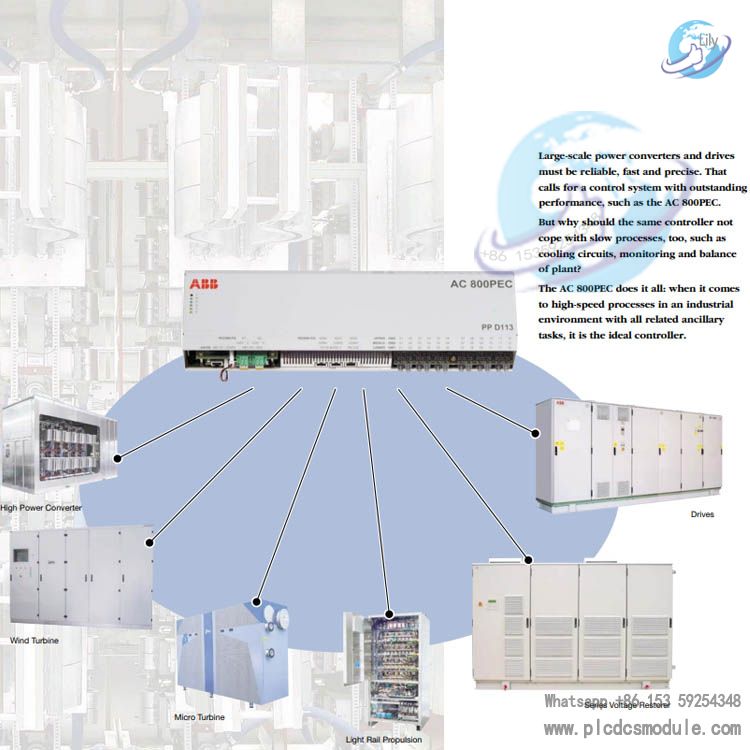
Core Positioning & Design Philosophy of AC 800PEC
AC 800PEC belongs to the ABB ControlIT industrial automation product line and is an integrated controller designed specifically for power electronics applications. Its core design goals:
- Single controller for dual tasks: Simultaneously meet high-speed power electronics control (converter drive, pulse modulation, fast protection) and low-speed process control (loop control, status monitoring, data acquisition), replacing the “high-speed controller + PLC” combination.
- Strong anti-interference industrial-grade design: Full-fiber communication, fanless cooling, solid-state storage, suitable for strong electromagnetic, wide-temperature, and high-dust environments such as substations, wind turbine towers, locomotives, and industrial sites.
- Seamless integration across the ecosystem: Compatible with ABB IndustrialIT software system, standard fieldbuses, and third-party upper systems, reducing engineering development and system docking costs.
- Modular and flexible configuration: Supports local/remote distributed installation, and modules can be freely combined according to I/O points, control logic, and communication requirements, adapting to systems from small single machines to large multi-cabinet setups.
By combining IEC 61131-3 standard programming and MATLAB/Simulink real-time simulation development, the product balances ease of use for conventional automation engineers and professional development needs for power electronics experts, making it an ideal choice for high-end equipment control.
In-Depth Analysis of AC 800PEC Hardware Architecture
AC 800PEC adopts a modular hardware design. All modules support DIN-rail or wall-mounted installation, with forced air-free cooling, low power consumption, and high reliability. The core hardware components and performance parameters are as follows:
1. Core CPU Module
- Processor: 750 MHz PowerPC 750FX RISC processor with a 64-bit IEEE floating-point unit (FPU), optimized for high-speed control algorithms.
- Memory configuration: 64 MB SDRAM cache (running real-time programs) + 16 MB Flash solid-state storage (saving programs and data). No battery backup required, and data is retained after power failure.
- Hardware acceleration: Built-in FPGA (Field Programmable Gate Array) independently processes ultra-high-speed timing-critical tasks such as pulse width modulation, pulse logic, and fast protection without occupying CPU resources.
2. Interface & Communication Modules
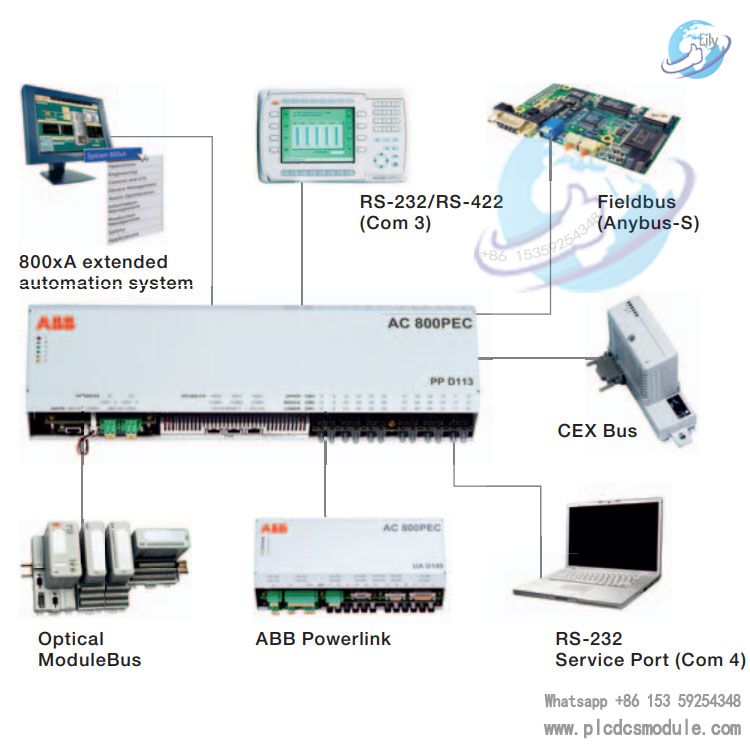
- Optical fiber interface: Supports up to 36 bidirectional optical fiber PowerLinks. Full optical isolation between the controller and I/O modules completely eliminates electromagnetic interference, with long transmission distance and strong stability.
- Ethernet interface: 2 independent Ethernet TCP/IP ports for connecting to upper-level SCADA, engineer stations, and other controller modules.
- Serial interface: RS-232/RS-422 service serial port, suitable for local operation panels, commissioning terminals, and third-party serial devices.
Expansion bus: 2 AnyIO ports supporting CEX bus expansion and AnyBus-S fieldbus modules, compatible with all mainstream industrial protocols.
3. Dedicated I/O Modules
AC 800PEC is equipped with a series of dedicated I/O modules covering high-speed acquisition, pulse output, direct converter drive, etc., different from conventional PLC I/O:
- Combi IO UA D149 (High-Speed Mixed I/O)
- Core purpose: Analog/digital acquisition and output for fast closed-loop control.
- Configuration: Base module UA D141 + up to 2 mixed IO boards UA D142.
- Single-point parameters: 16 high-speed digital inputs / 8 high-speed digital outputs, 6 high-speed analog inputs, 2 high-speed analog outputs.
- Adaptation: Can be equipped with low voltage divider (LVD, up to 1000 Vrms), high voltage divider (HVD, up to 6000 Vrms), CT/VT sub-boards to adapt to different voltage and current levels.
- PECMI UA D140 (High-Speed Measurement Interface)
- Core purpose: High-precision fast acquisition of current and voltage, suitable for power electronics converters and reactive power compensation devices.
- Functions: Supports 4 active scalable current inputs, voltage divider/CT/VT sub-board access, with built-in protection circuits.
- PINT DD C779 (Thyristor Pulse Interface)
- Core purpose: Direct drive of thyristor converter arms, suitable for rectification, reactive power compensation, and HVDC power transmission.
- Capacity: Single board controls 2 independent 6-pulse thyristor converter arms, with pulse logic implemented in hardware.
- PEBB Interface Boards (GD D160/D165)
- GD D160: Directly drives 2 IGBT converters (2×6 pulses), expandable to 6 units.
- GD D165: Directly drives 4 IGBT arms (4×6 pulses), suitable for high-power PEBB (Power Electronic Building Block) converters.
- AC 800PEC INT Interface System
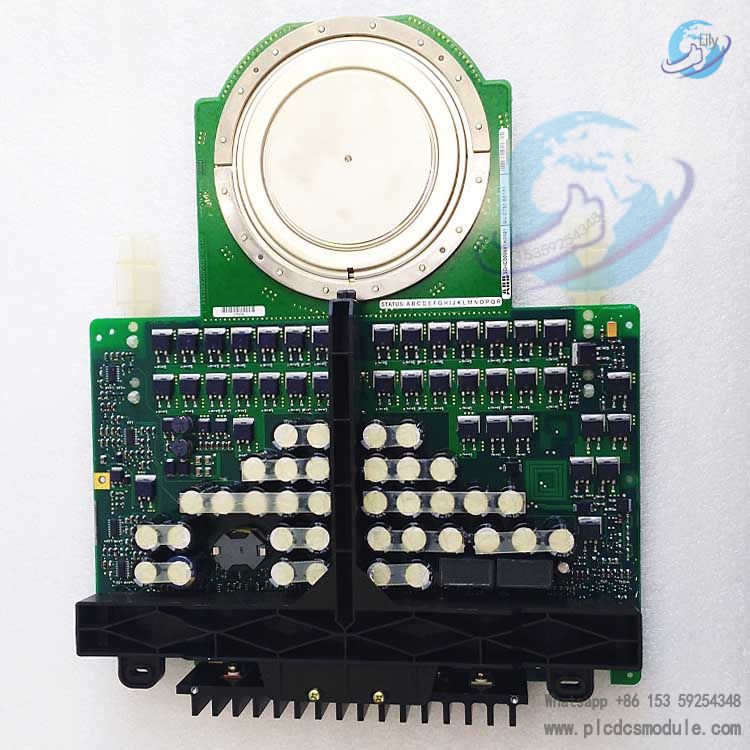
- Core purpose: Direct control of IGCT converters, with 6 optical transmit/receive channels built-in, and full hardware pulse logic.
- Standard ABB S800 I/O Compatibility
- Low-speed signals (temperature, pressure, liquid level, general switching values) can be directly connected to ABB S800 I/O modules via optical fiber or bus, maximizing compatibility with the existing ABB ecosystem.
4. Core Hardware Advantages
- Fanless design: Low-power circuits, natural cooling, no mechanical failure points, greatly improved MTBF (Mean Time Between Failures).
- Full optical isolation: No electrical connection between the controller and I/O/converters, stable operation in strong electromagnetic environments.
- Distributed installation: Modules can be installed locally centrally or remotely distributed, adapting to dispersed I/O requirements of large equipment.
- Wide-temperature stability: Industrial-grade wide-temperature design, meeting harsh environments such as rail transit, wind power, and field substations.
AC 800PEC Software System & Development Platform
AC 800PEC adopts a three-level hierarchical software architecture, balancing conventional automation development and high-speed power electronics algorithm development, supporting a standardized toolchain to lower engineering barriers:
1. Three-Level Software Architecture
- Level 1: IndustrialIT Integration Layer (Conventional Control)
- Based on the international standard IEC 61131-3, programmed with ABB Control Builder M.
- Responsible for low-speed process control: cooling circuits, status monitoring, operation display, data recording, interlock protection.
- Seamlessly connects to ABB upper systems such as OperateIT and Process Portal, supporting custom operation panels.
- Level 2: Fast Control Layer (Algorithm Core)
- Development tools: MATLAB/Simulink + Real-Time Workshop.
- Responsible for fast closed-loop control algorithms with a control cycle of 100 μs to several ms, suitable for converter closed-loop regulation, power control, voltage and current stabilization.
- The simulation model directly generates real-time code and downloads it to the controller, greatly shortening the commissioning cycle.
- Level 3: High-Speed I/O Control Layer (Hardware-Level Logic)
- FPGA-based hardware programming, developed in VHDL language.
- Responsible for ultra-high-speed tasks: PWM pulse width modulation, pulse generation, hardware protection, fast I/O read/write, typical cycle 25 μs.
- Hardware-level execution with no software delay, response speed far exceeding conventional PLC and general controllers.
2. Dedicated Engineering & Commissioning Tools
- Control Builder M: IEC 61131-3 standard programming tool supporting ladder diagram, function block, structured text, easy for conventional automation engineers to get started.
- PECView: PC-based dedicated commissioning tool for monitoring, analyzing, fault diagnosis, and parameter tuning of Simulink applications, supporting online debugging and offline analysis.
- Process Panel Builder: Operation panel configuration tool with a rich built-in graphics library, quickly customizing human-machine interfaces, and standardized panels reducing configuration time.
- AC 800PEC dedicated add-on: Licensed with hardware, fully integrated into the ControlIT engineering environment for unified project management.
AC 800PEC Communication & Bus Capabilities
AC 800PEC is an open control system supporting mainstream industrial fieldbuses and Ethernet communication, perfectly connecting to third-party devices and upper systems:
1. Mainstream Fieldbus Support
- Slave protocols: Profibus-DP, Modbus-RTU, CANopen, Interbus, LonWorks
- Master protocols: Profibus-DP, MB300, Ethernet
- Extended communication: CEX bus, compatible with all ABB AC 800 series communication modules, suitable for rail transit and traction drive applications.
2. Upper-Level Communication
- Dual Ethernet TCP/IP: Connect to factory SCADA, MES systems, engineer stations, and redundant controllers.
- Remote service: Local debugging via RS-232 serial port, supporting remote diagnosis and maintenance.
3. Core Communication Advantages
- Multi-protocol parallel operation: High-speed control bus + conventional fieldbus + upper-level Ethernet run independently without interference.
- Optical fiber communication anti-interference: Zero packet loss and zero delay in strong electromagnetic environments (near converters and high-voltage equipment).
- Distributed expansion: Supports multi-controller networking, adapting to collaborative control of large multi-unit equipment.
5. Typical Application Scenarios of AC 800PEC
With the advantages of high-speed real-time performance, strong anti-interference, and integrated control, AC 800PEC is widely used in industries with extremely high requirements for control accuracy and reliability:
- High-power power electronics convertersRectifiers, inverters, active power filters (APF), static synchronous compensators (STATCOM), SVC dynamic reactive power compensation.
- New Energy Power Generation & Energy StorageWind power grid-connected converters, photovoltaic inverters, energy storage converters (PCS), micro-turbine control systems.
- Rail Transit & Traction DrivesLight rail/subway traction control systems, locomotive converter control, EMU auxiliary converter control.
- High-Voltage Direct Current (HVDC) TransmissionIGCT/IGBT HVDC control, thyristor converter valve control.
- Industrial Heavy-Duty DrivesRolling mill main drives, hoist drives, high-precision drives for large fans/pumps, synchronous drive systems.
- Special Power EquipmentSeries voltage restorers, pulse power supplies, industrial test platforms, high-precision power experimental devices.
6. Full Series AC 800PEC Product Model Recommendations
Combined with document parameters and actual industrial project requirements, recommended by core controller, dedicated I/O module, supporting interface board, covering more than 90% of application scenarios:
1. Core Controller Models
(1) AC 800PEC PP D113
- Order No.: 3BHS201058E01 (document standard model)
- Positioning: Standard universal type, first choice for medium and small power converters, wind power, energy storage, rail transit.
- Adaptation: Single-cabinet systems, conventional I/O points, non-redundant high-speed control scenarios.
- Highlights: Complete CPU + optical fiber interface + CEX expansion, compatible with all dedicated I/O modules.
(2) AC 800PEC BP Backplane
- Positioning: Basic installation carrier of the system, used to install CPU, power supply, optical interface, and communication modules.
- Advantages: Standardized slots, modular flexible configuration, supporting redundant configuration.
2. Dedicated I/O & Interface Modules
Required for High-Speed Control
- Combi IO UA D149: High-speed analog/digital mixed I/O, core module for fast closed-loop control.
- PECMI UA D140: High-speed current and voltage measurement, essential for converter sampling.
Required for Converter Drive
- PINT DD C779: Special pulse interface for thyristor converters.
- PEBB GD D160: 2-arm drive for IGBT converters.
- PEBB GD D165: 4-arm drive for IGBT converters.
- AC 800PEC INT: Special interface for high-power IGCT converters.
Low-Speed Signal Expansion
- Full series of ABB S800 I/O: Suitable for low-speed signals such as temperature, pressure, and general switching values.
3. Quick Selection Guide
- Medium and small power converters / energy storage PCS → PP D113 + Combi IO UA D149 + PECMI UA D140
- Thyristor rectification / reactive power compensation → PP D113 + PINT DD C779
- High-power IGBT/IGCT converters → PP D113 + PEBB GD D165 + INT interface
- Rail transit traction → PP D113 + Traction DA D143 module + S800 I/O
Core Value of Choosing ABB AC 800PEC
- Cost reduction by more than 30%Single controller replaces high-speed controller + PLC, reducing hardware, wiring, cabinet space, and maintenance costs, and lowering system failure points.
- Leap in control performanceFastest 25 μs control cycle, hardware-level FPGA protection, dynamic response far exceeding conventional PLC, improving product accuracy and stability.
- Development cycle shortened by 50%IEC 61131-3 + Simulink dual platform, simulation direct download, no repeated coding, more efficient commissioning.
- Industrial-grade high reliabilityFull optical isolation, fanless, Flash battery-free storage, long-term stable operation in strong electromagnetic and wide-temperature environments.
- Ecosystem compatibility without barriersCompatible with ABB’s full range of products and mainstream fieldbuses, zero obstacles to connecting upper systems and third-party devices.
Conclusion
For high-end industrial fields such as power electronics, new energy, rail transit, HVDC power transmission, and heavy-duty drives, integration of high-speed control and process control is a core trend to reduce costs, improve efficiency, and enhance product competitiveness.
With the advantages of modular hardware, microsecond-level performance, three-level software architecture, full optical fiber anti-interference, and full ecosystem compatibility, ABB AC 800PEC has become the preferred solution for global high-end equipment control.
Whether it is single-machine converter control, large-scale wind power/energy storage systems, rail transit traction, or HVDC power transmission projects, AC 800PEC can provide a stable, efficient, and easy-to-maintain integrated control solution, helping enterprises shorten R&D cycles, reduce operation and maintenance costs, and increase equipment added value.
The AC 800PEC adopts DIN rail mounting.
Ethernet is the preferred medium for configuration of this controller and communication with upper-level control systems. The AC 800PEC connects to ABB I/O systems via the optical fiber S800 module bus, interfaces with ABB communication modules through the Communication Extension bus (CEX), and also supports third-party AnyBus-S® fieldbus modules.
The I/O modules of the AC 800PEC are connected via high-speed point-to-point links. This controller supports up to 36 bidirectional optical fiber power links.
The AC 800PEC control system consists of a series of modules, which can be arranged according to the required I/O configuration and process requirements.
System Components of AC 800PEC
- AC 800PEC Controller Module
- AC 800PEC Combined I/O Module
- AC 800PEC INT Interface Module
- S800 I/O Module
- CEX Bus Extension Module
- AC 800PEC PEBB Interface Board
- AC 800PEC Measurement Interface
Model List
PPC905AE101PPC907PPC907BEPPC907BE101PPD113B01-10-150000PPD113B03-26-100110PPD115A102PPD512PPD512A10-4540003BHE040375R103EPPD539A1023BHE039770R0102PPEO91A101PVD164UAD149PPD113DDC779GDD160GDD165UAD144S800 I/OCI85xTB820TB830TB831