Note; All products on this site are special products, the market price has been fluctuating, the specific customer service offer shall prevail, because the product is a new product, the picture is not a real shot, please confirm with customer service before placing an order model and product, price and other details, the site used, new are for sale, please contact customer service communication. The ABB PM861AK01 is a high-performance processor unit controller belonging to the Classic System 800xA series, with the product code 3BSE018157R1 and its lifecycle status classified as Classic. Centered on a modular design, this controller integrates robust computing, communication and redundancy functions. Boasting high reliability, convenient installation and maintenance features, as well as broad environmental adaptability, it is suitable for industrial automation control scenarios. It can be flexibly configured via 800xA Control Builder, fully meeting the precise execution requirements of various industrial control tasks.
Part number: PM861AK01
Part No:3BSE018157R1
Manufacturer:ABB
Product Description:Processor unit controller
PM861AK01 Processor Unit Kit
Includes:
-PM861A, CPU
-TP830, Base Plate, Width = 115mm
-TB850, CEX-bus Terminator
-TB807, ModuleBus Terminator -TB852
-TB852, RCU-Link Terminator
related documents
 PM861AK01.pdf
PM861AK01 Processor.pdf
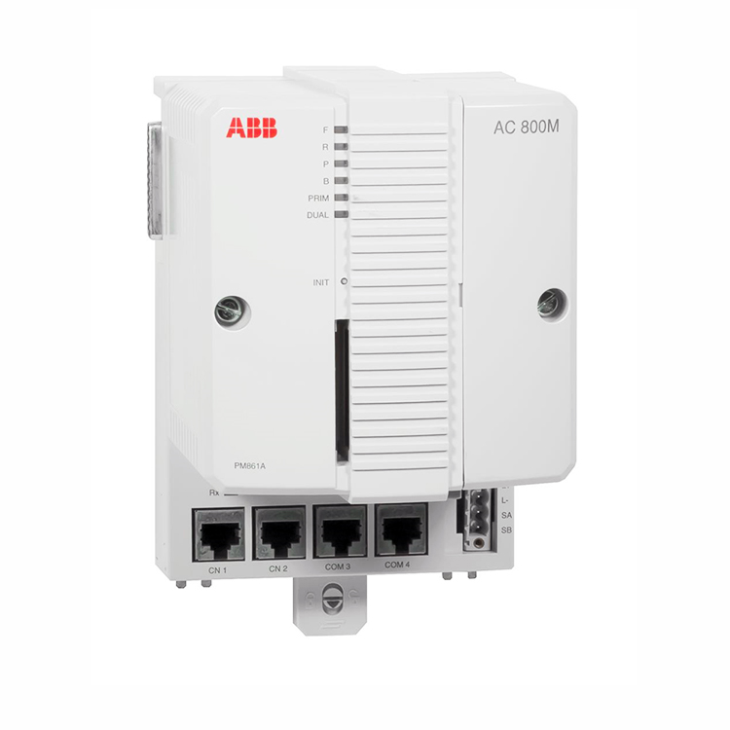
Core Hardware Configuration and Structural Design
Core Computing and Storage Components
The controller CPU board is equipped with an MPC860 processor running at a clock frequency of 48 MHz, delivering robust computing performance. It only takes 0.23 ms to complete 1,000 Boolean operations, enabling efficient processing of complex control logic. In terms of storage, it is configured with 16 MB of memory, of which 7.155 MB is available for application program execution. Meanwhile, it has a built-in 2 MB Flash PROM for firmware storage and a Flash memory for data storage, ensuring the stable preservation of programs and data. In addition, the controller incorporates a 3.6 V lithium battery as the backup power supply, paired with a real-time clock that boasts a clock stability of 100 ppm (equivalent to an annual error of approximately 1 hour). It also supports 1 ms-level clock synchronization between AC 800M controllers via the CNCP protocol, guaranteeing the accuracy of control timing.
Interface and Communication Capabilities
Ethernet Interfaces
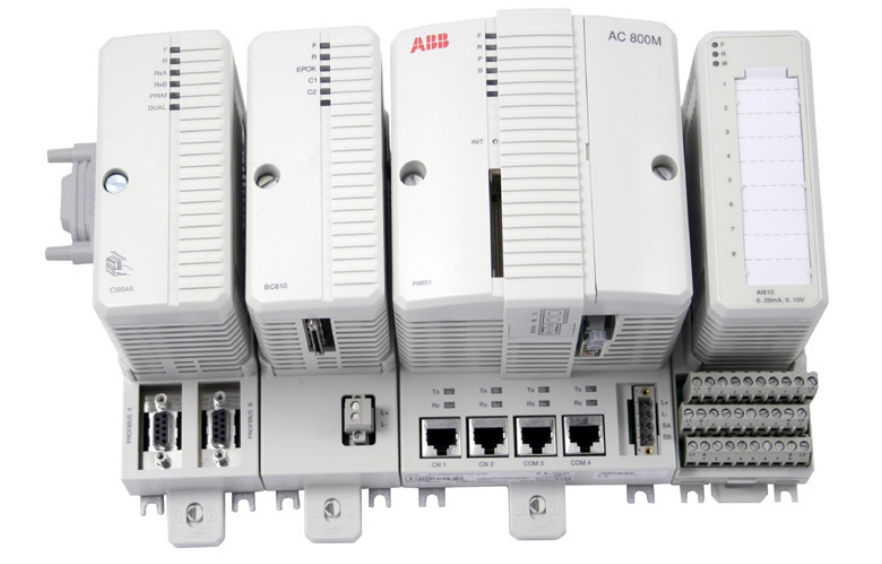
The base board is fitted with 2 RJ45 Ethernet ports (CN1, CN2), compliant with the IEEE 802.3 standard and supporting a transmission rate of 10 Mbit/s. These ports are compatible with the Manufacturing Message Specification (MMS) and Inter-Application Communication (IAC) protocols. It is recommended to deploy a 100 Mbit/s switched Ethernet as the backbone of the control network. Moreover, the board is provided with built-in redundant Ethernet communication ports to enhance communication reliability.
Serial Interfaces
It offers 2 RJ45 serial ports (COM3, COM4), both of which are RS-232C interfaces. The COM3 port supports a baud rate ranging from 75 to 19200 bps, features full RTS-CTS support, and adopts a non-optically isolated design, making it suitable only for non-redundant configurations. The COM4 port has a fixed baud rate of 9600 bps, employs an optically isolated design without RTS-CTS support, and is also limited to non-redundant configurations, mainly used for connecting configuration tools.
Expansion Buses
- CEX-Bus: It supports the segmented CEX-Bus, which can be expanded via a pair of BC810 modules to connect up to 12 communication modules, with the maximum supply current of the CEX-Bus reaching 2.4 A.
Modulebus: For non-redundant CPU configurations, it supports 1 electrical + 7 optical I/O clusters; for redundant CPU configurations, it supports 7 optical I/O clusters. A single PM861A controller can support a maximum of 96 I/O modules in non-redundant mode and 84 I/O modules in redundant mode. The Modulebus scanning rate is adjustable within the range of 0–100 ms (the actual rate depends on the number of I/O modules).
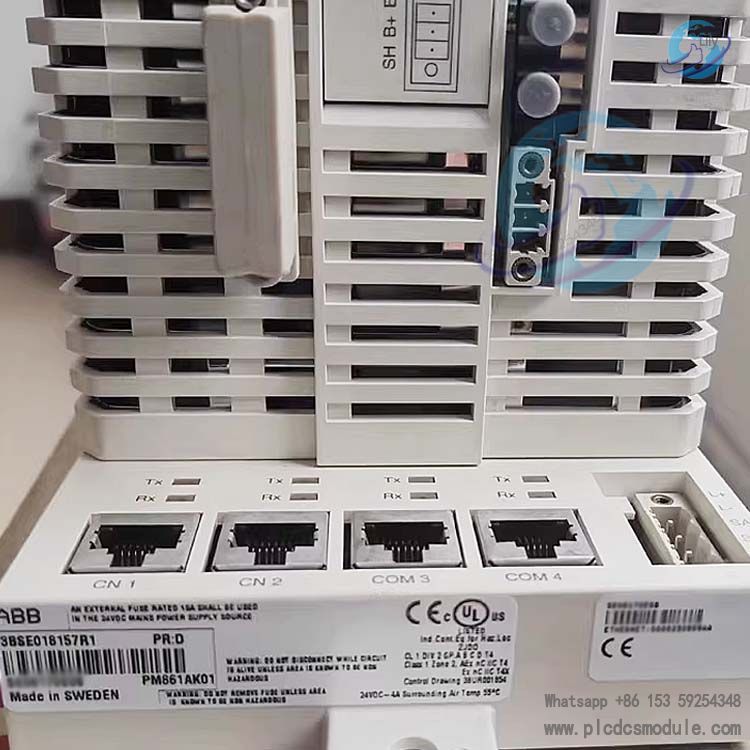
Installation and Labeling Design
The controller adopts a unique sliding locking mechanism, enabling quick installation and removal on DIN rails for easy operation. All base boards are assigned a unique Ethernet address, which serves as the exclusive hardware identifier for each CPU and can be found on the Ethernet address label attached to the TP830 base board. The product has an IP20 protection rating, meeting the basic protection requirements of industrial environments without the need for an additional enclosure. With a compact structure that saves installation space, it has dimensions of 196 mm (7.3 inches) in width, 119 mm (4.7 inches) in height, 135 mm (5.3 inches) in depth, and weighs approximately 1200 g (2.6 pounds).
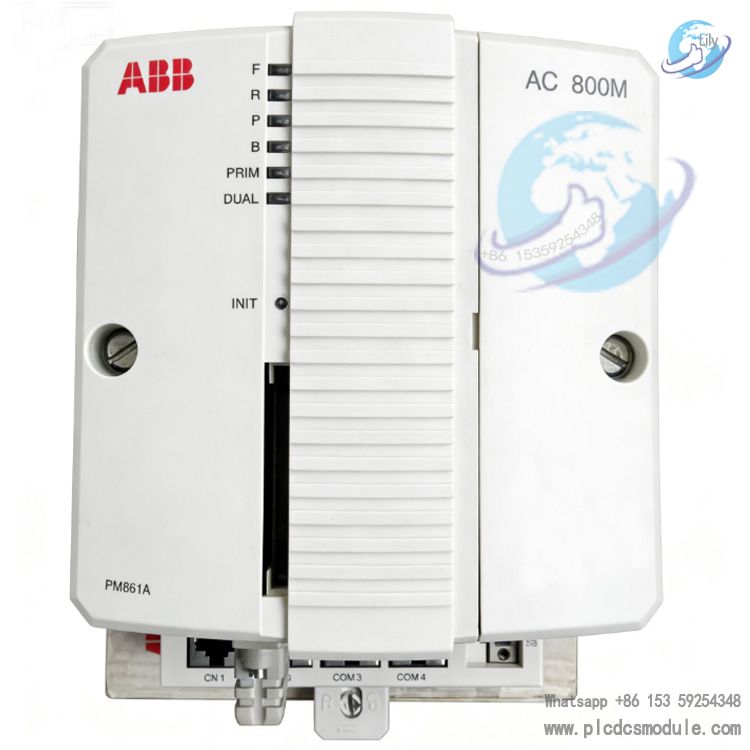
Performance Parameters and Functional Features
Redundancy and Availability
It supports CPU redundancy configuration, covering the redundant backup of key components such as the CPU, CEX-Bus, communication interfaces, and S800 I/O. The maximum redundancy switching time is 10 ms, which greatly improves system availability and reduces the risk of downtime caused by faults. Additionally, it is equipped with a redundant power supply status input function to further enhance power supply reliability.
Software Configuration Capabilities
A single controller can support up to 32 application programs, with each application containing 64 programs and 128 charts. The controller as a whole supports a maximum of 32 tasks and 32 different cycle times, with the minimum application cycle time down to 1 ms, enabling flexible adaptation to the timing requirements of different control scenarios. In terms of data interaction, each OPC client can have a maximum of 3000 event queues in the controller. The transmission rate from the AC 800M to the OPC server ranges from 36–86 events per second and 113–143 data messages per second, ensuring high efficiency of data transmission.
Power Supply and Power Consumption
The supply voltage range is 24 V DC (19.2–30 V DC). Under +24 V power supply, the typical power consumption current is 250 mA and the maximum is 430 mA; the typical power loss is 6.0 W and the maximum is 10.3 W, featuring reasonable energy consumption control and suitability for long-term stable operation. The electrical Modulebus provides 24 V (maximum 1.0 A) and 5 V (maximum 1.5 A) supply currents to meet the power requirements of various I/O modules.
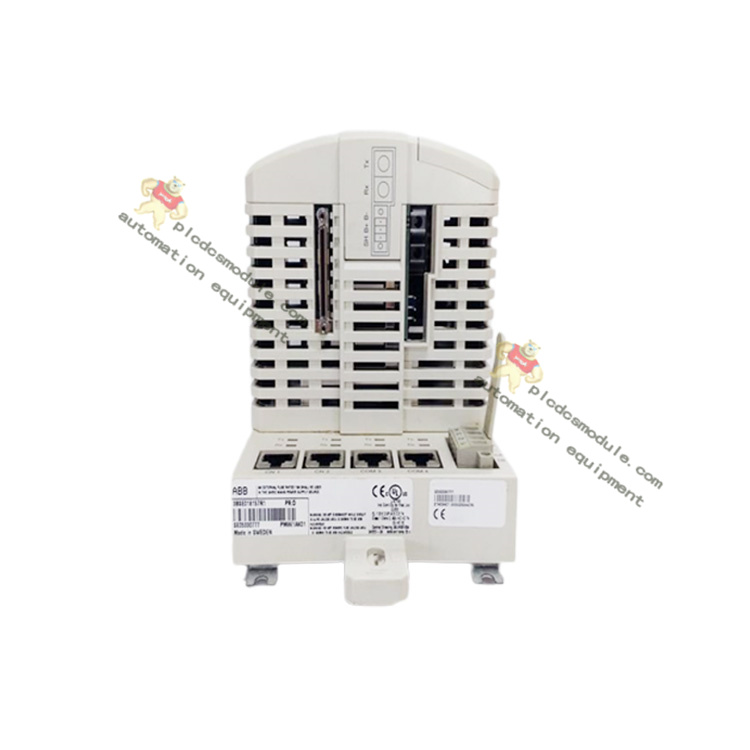
Environmental Adaptability and Certifications
Environmental Operating Conditions
- Operating temperature range: +5 °C to +55 °C (+41 °F to +131 °F)
- Storage temperature range: -40 °C to +70 °C (-40 °F to +158 °F)
- Temperature change rate: Compliant with IEC/EN 61131-2 standard, maximum 3 °C/min
- Operating altitude: Compliant with IEC/EN 61131-2 standard, up to 2000 m
- Relative humidity: 5% to 95%, non-condensing
- Vibration resistance: 0.0375 mm amplitude at 10 < f < 50 Hz; 0.5 g acceleration at 50 < f < 150 Hz; 0.2 g acceleration at 5 < f < 500 Hz
- Pollution degree: Compliant with Class 2 of IEC/EN 61131-2 standard
- Corrosion protection: Compliant with Grade G3 of ISA 71.04 standard
Customers who purchased this product are also browsing the following products:
ABB PM864AK01 3BSE018161R1 AC800M Processor Unit module
ABB PFTL201D-100KN 3BSE008922R0100 Millmate horizontal pillow block tensiometer
ABB PM864AK01-eA 3BSE018161R2 AC800M Processor Unit module
ABB PM866AK01 3BSE076939R1 Processor Unit module