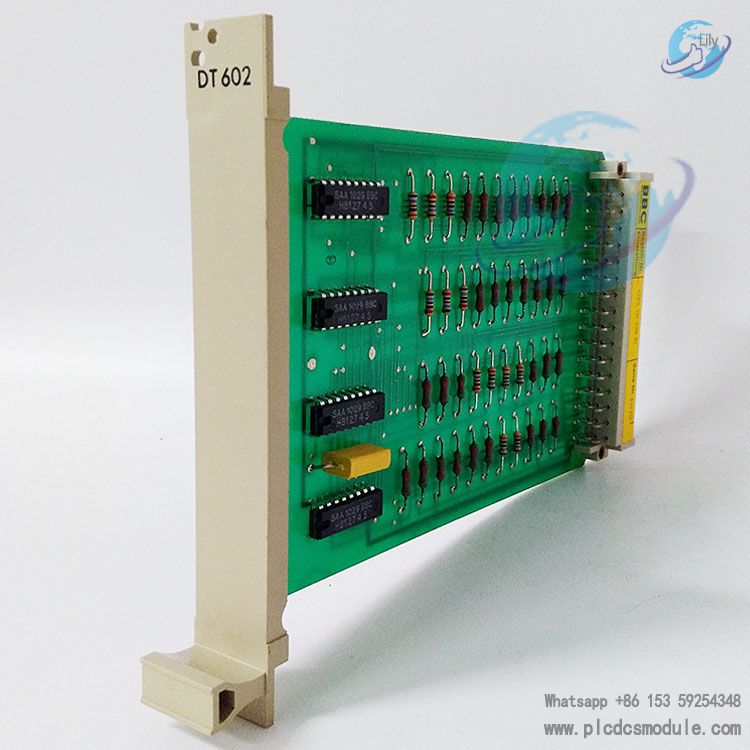
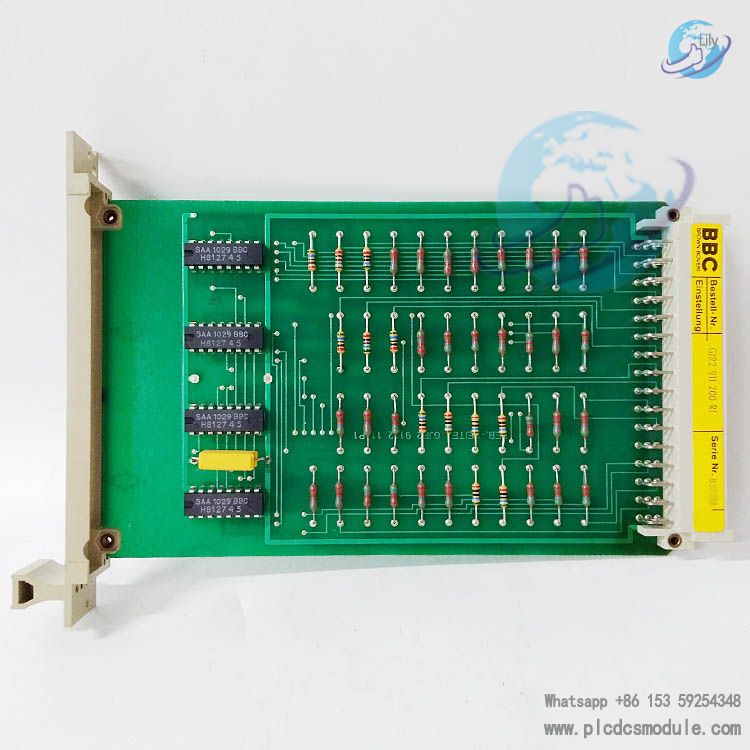
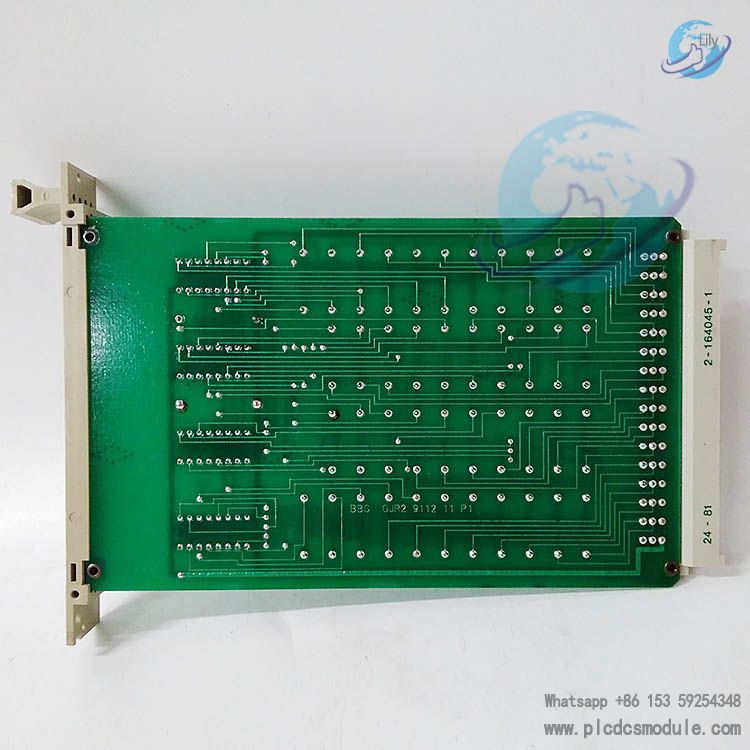
Note; All products on this site are special products, the market price has been fluctuating, the specific customer service offer shall prevail, because the product is a new product, the picture is not a real shot, please confirm with customer service before placing an order model and product, price and other details, the site used, new are for sale, please contact customer service communication. ABB DT602 GJR2911200R1 Analog Input Module is mainly used to accurately convert analog signals (such as voltage and current signals) output by on-site devices like sensors into digital signals, which are then transmitted to digital control systems such as PLCs for data processing and analysis. It features independent multi-channel configuration, high-precision conversion, and excellent anti-interference capability, which can meet the analog signal acquisition requirements in various industrial scenarios including chemical industry, electric power and manufacturing, and ensure the accuracy of data acquisition and the operational stability of systems during industrial production processes. Adopting a standardized design, this module can be easily integrated into the relevant ABB control system architecture with relatively simple installation and maintenance operations, providing reliable hardware support for the efficient realization of industrial automation control.
Core Functions
Multi-channel Signal Acquisition: The module is equipped with 4 independently configurable analog input channels, each of which can be flexibly set to voltage input or current input mode. It is compatible with different voltage signals such as 0V - +5V and 0V - +10V, as well as current signals such as 0mA - 20mA and 4mA - 20mA, and can collect signals output by multiple sensors of different types simultaneously, improving the flexibility and efficiency of signal acquisition.
High-precision Analog-to-Digital Conversion: The module features a 12-bit conversion resolution. At the standard temperature (+25°C), the typical conversion error of voltage signals is only ±0.5% of the full scale; that of 0mA - 20mA current signals is also ±0.5% of the full scale, and the typical conversion error of 4mA - 20mA current signals is ±0.7% of the full scale. It ensures the accuracy of converting analog signals to digital signals and provides data support for the precise control of the control system.
Signal Processing and Protection: The module has a built-in input filter with a time constant of 300μs for both voltage and current inputs, which can effectively filter out noise interference in signals and ensure signal stability. For voltage input channels, it is equipped with an overvoltage protection function of up to 30V DC to avoid module damage caused by abnormally high input voltage and extend the service life of the module.
Adaptability and Compatibility: It supports differential input mode and can work normally when the sum of signal voltage and common-mode voltage is controlled within the range of ±12V, adapting to the signal environments of various complex industrial sites. It has good compatibility with ABB-related PLCs and control systems, and can be quickly integrated into the existing control system to achieve seamless data transmission and interaction.
Convenient Configuration and Management: Unused input channels can be directly open-circuited and set to the "Unused" state through system configuration, simplifying on-site wiring operations. The typical analog-to-digital conversion time of a single channel is 500μs, which can complete signal conversion quickly and meet the real-time signal requirements in industrial control.
Technical Parameters
Channel Parameters: 4 independently configurable channels with 1 channel group (4 channels per group); the input resistance is more than 1MΩ for voltage input and approximately 250Ω for current input; the input data length is 8 bytes.
Conversion Performance: The resolution is 12 bits for both voltage signals (0V - +5V, 0V - +10V) and current signals (0mA - 20mA, 4mA - 20mA); within the temperature range of 0°C - +60°C or in the presence of EMC interference, the maximum conversion error of all signal types is ±2% of the full scale; the typical analog-to-digital conversion time of a single channel is 500μs.
Wiring and Transmission: The signal connection terminals are clearly defined; signals I0 + to I3 + are connected to terminals 2, 5, 8 and 11 respectively, and signals I0 - to I3 - are connected to terminals 3, 6, 9 and 12 respectively. When the cross-sectional area of the wire is larger than 0.14mm², the maximum connection length of unshielded wires is 10m, and that of shielded wires can reach 100m, adapting to the wiring requirements of different industrial sites.
Operating Environment: It can work stably in the temperature range of 0°C - +60°C, adapting to the common temperature changes in industrial sites; it has good electromagnetic compatibility and can operate normally in industrial environments with electromagnetic interference, ensuring that signal acquisition and conversion are free from interference.
Power Supply and Installation: It is compatible with the common DC power supply in industry, and the power connection shall comply with the power distribution specifications of ABB control systems. The internal power distribution is realized through the system's bus board. It can be embedded into a standard I/O subrack during installation and work collaboratively with other modules to form a complete input unit of the control system.
Application Scenarios
The DT602 GJR2911200R1 Analog Input Module is widely used in various industrial automation control scenarios. In the petrochemical industry, it is applied for the acquisition of production process parameters, capturing analog signals output by sensors for pressure, temperature, flow rate and other metrics to provide data for the monitoring and regulation of production processes. In power systems, it is used to collect analog signals such as current, voltage and power, supporting the monitoring of operational status and fault diagnosis of power systems. In production line control within the manufacturing industry, it can acquire analog signals from various testing equipment to realize real-time control of product production quality. It is also suitable for the signal acquisition link in the automation control processes of multiple industries including water treatment and metallurgy.