

Kongsberg RCU510 Remote Controller Unit(Part No. 601418)
Product Overview
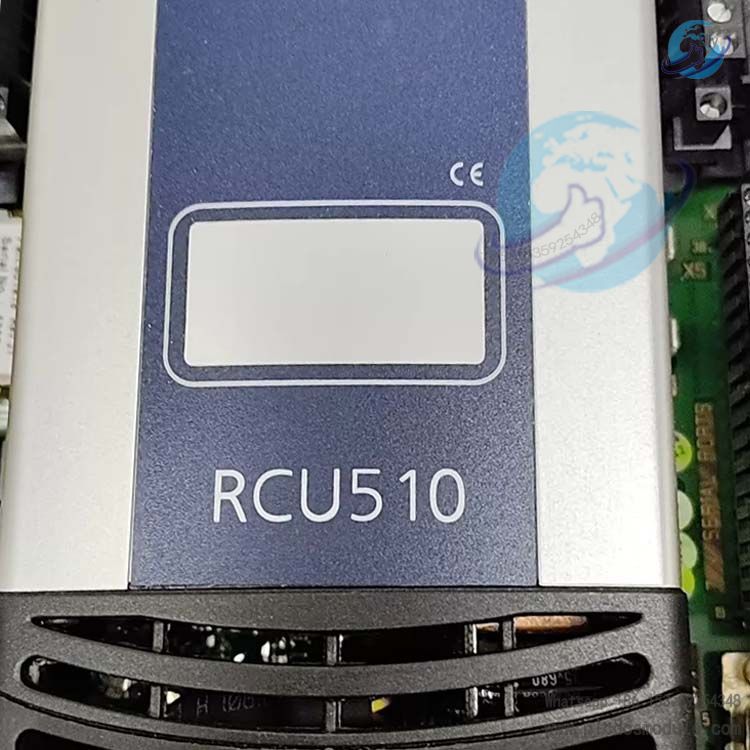
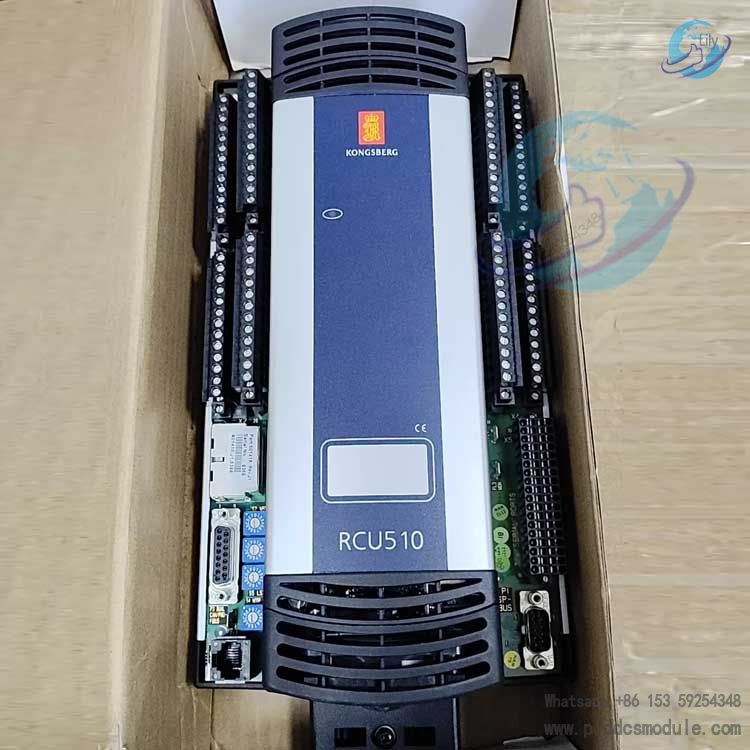
Kongsberg RCU510 is a remote controller unit developed for process control, belonging to the core hardware of Kongsberg marine automation hardware platform. It integrates a single-board real-time computer, remote IO bus driver and multi-channel IO processing controller. RCU510 (601418) is equipped with complete field channels, directly connecting field sensors and actuators, running process control system applications, and interfacing with multiple field buses and network interfaces. It has obtained DNV and ABS type approvals, meeting strict working conditions of ships and offshore platforms.
RCU510 (601418) can connect to the SPBus remote IO subsystem. Matched with supporting IO modules, it realizes distributed monitoring. It is widely used in cabin monitoring, propulsion auxiliary control and equipment interlock protection scenarios of the K‑Chief automation system.
Specifications & Parameters
Core Computer: 32-bit MPC8245 PowerPC CPU, 400MHz
Memory: 32MB ECC 64-bit 133MHz SDRAM
Flash: 16MB Flash memory
DSP: Built-in DSP for RIO subsystem management and data filtering
Total I/O: 32-channel universal I/O
20 composite channels AI/AO/DI/DO; AI supports current, voltage, PT100 RTD, potentiometer; AO available only on channel 1‑16 for current/voltage output; DI supports passive contact, Namur signal; DO high-side drive output
4 relay output channels; 8 channels ±10V AI/AO; all I/O except 4 relay channels support circuit monitoring
Communication: 7 × RS‑232/422/485 serial ports (2 isolated); 1 × SPBus serial process bus; Dual CAN (option board); Dual Profibus (option board); Dual Ethernet 10/100BASE‑T
Power Supply: 24VDC±20%; Max Power: 20W plus loop supply
Terminal: 2.5mm² screw terminal
Dimension: H355mm × W158mm × D87mm; Weight: 1.35kg
Protection: IP20
Operating Temp: 0℃‑70℃; Storage Temp: -25℃‑70℃
Humidity: Up to 98% RH non-condensing
Compliance: IEC61131‑2, IEC60945, IACS E10; DNV, ABS type approval, CE marked
Diagnostics: Built-in BIST; high temp, undervoltage, fan alarm input; 1 run/fault LED, 8 status LEDs
Function Description
As a local control node of distributed control system, RCU510 (601418) directly processes field analog and digital signals. The DSP independently manages the remote IO subsystem for signal filtering and wire break diagnosis.
Multiple serial ports, field buses and Ethernet realize connection with field devices and data exchange with upper operator stations simultaneously.
Onboard BIST continuously checks hardware status, collects temperature, power and fan fault signals, and outputs equipment running status via LED indicators.
RCU510 (601418) can independently undertake small-scale local control tasks, or act as a field controller for K‑Chief system, linking external RIO modules to expand points for monitoring and logic control of marine engine room and offshore platform equipment.
Main Functions & Features
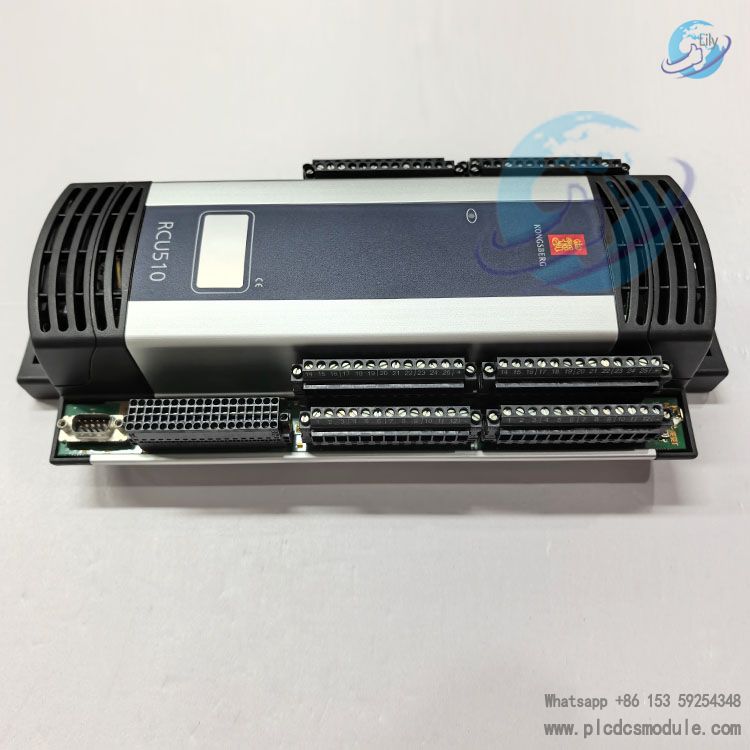
32 integrated I/O channels, directly connecting field instruments, valves and switches without extra IO backplane, reducing hardware inside cabinet
DSP co-processor handles I/O and bus calculation, main CPU runs control application to guarantee real-time response
Most I/O channels support circuit monitoring to detect wire break and short circuit for fast troubleshooting
Rich multi-protocol interfaces: serial, SPBus, CAN, Profibus and dual Ethernet, compatible with third-party devices and Kongsberg subsystems
Complete hardware fault detection for power, temperature and fan; fault status visualization
Marine wide-temperature design for high humidity and vibration offshore environments, certified by major marine classification societies
Product Characteristics
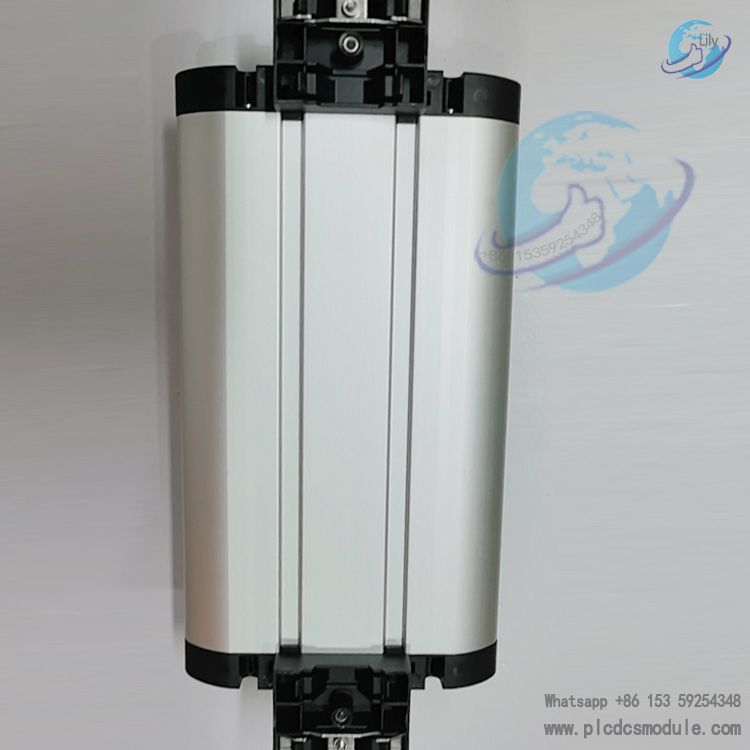
RCU510 (601418) adopts DIN rail mounting and integrated modular design. Dual Ethernet ports support redundant networking; isolated serial ports reduce ground loop interference for marine systems.
SPBus supports Manchester coding for multi-drop remote IO units. Onboard memory with ECC correction lowers memory error risk caused by EMI in industrial environments.
Relay channels are independent without circuit monitoring, suitable for high-power switching output. All hardware specifications fully meet marine automation standards.
IP20 rated for installation inside control cabinets only, not for direct outdoor exposure.
Product Advantages
RCU510 (601418) integrates abundant local I/O, reducing purchase of additional IO modules and saving cabinet space in projects.
DSP + main CPU architecture separates I/O processing from control logic, stable real-time performance.
Supports multiple industrial buses, convenient for retrofitting old vessel automation and compatible with legacy equipment.
Built-in comprehensive self-diagnosis shortens fault location time.
Dual certification of DNV and ABS to satisfy different shipowner and class society requirements.
Low typical power consumption of 20W, less heat load for cabinet cooling.
Application Scenarios
Ship engine room automation control system
Offshore platform process monitoring system
Dynamic positioning auxiliary control system
Propulsion system local logic control
Ballast and bilge water monitoring & interlock on vessels
Local acquisition and control for offshore oil & gas equipment
Ship automation retrofitting and upgrade projects
Usage Purpose
Remote control node for collecting temperature, pressure and level sensor signals
Analog output for regulating valves and actuators
Read equipment status, output digital and relay commands for start/stop and interlock protection
Expand distributed remote I/O via SPBus
Exchange process data with operator stations and other RCU controllers over Ethernet
Connect third-party instruments and alarm units through serial ports
Report hardware self-test faults to system alarm platform
Same Brand Product Comparison
RCU510 (601418), RCU500 and RCU501 belong to RCU500 series. RCU510 has the maximum local I/O channels onboard and can handle many points without external IO modules. RCU500 and RCU501 have fewer onboard I/O and rely more on external RIO expansion.
RCU602 is the new-generation RCU platform with higher CPU performance but less integrated local I/O, designed for large redundant systems with higher cost. RCU510 is preferred for medium point count cabinets where fewer external IO modules are expected.
Matching Spare Parts
RDIO400 Remote Digital IO Module
RAIC400 Remote Analog Current Input Module
RAIV400 Remote Analog Voltage Input Module
RAOC400 Remote Analog IO Combined Module
RSER200‑4 Serial Expansion Module
RHUB200‑5 Bus Hub Repeater
RTB420 Remote Termination Board
BUS‑Term Bus Termination Board
Recommended Kongsberg Models
RCU500 Remote Controller Unit
RCU501 Remote Controller Unit
RCU502 Remote Controller Unit
RCU602 Remote Controller Unit
RDIO400 Remote Digital Input Output
RDIOR420 Remote Digital I/O Relay
RAIC400 Remote Analogue Input Current
RAIV400 Remote Analogue Input Voltage
RAOC400 Remote Analogue Output Combined
RMP420 Remote Multi‑Purpose I/O
RSER200‑4 Serial Interface Module
RHUB200‑5 Communication Hub
RTB420 Remote Termination Board
BUS‑Term Bus Termination Board
WBU Watch Bridge Unit
FAQ
Q: Can RCU510 part number 601418 be installed directly on open deck?
A: RCU510 is IP20, only for installation inside closed control cabinets. It cannot be exposed outdoors directly; deck installation requires a protective cabinet.
Q: Are all AO channels of RCU510 (601418) available for 1‑20mA?
A: AO function is only available on channel 1‑16. Composite channels 17‑20 have no AO capability. Channels 1‑16 can be configured for current or voltage mode.
Q: Can RCU510 directly replace RCU501?
A: Mechanical mounting dimensions are compatible, but I/O definition, firmware and project configuration differ. Direct replacement is not supported; project program reconfiguration is required.
Q: Does SPBus need extra terminating resistor?
A: The SPBus bus end needs BUS‑Term termination board for impedance matching; otherwise communication packet loss may occur.
Q: Why relay output channels of RCU510 (601418) have no circuit monitoring?
A: The 4 relay channels are not connected to the circuit monitoring circuit by hardware design. Fault detection on relay downstream loops needs external monitoring points.
Q: Can dual Ethernet ports of RCU510 work as a switch?
A: Dual Ethernet ports are independent controllers for network redundancy only. They have no layer-2 forwarding function and cannot replace industrial switches.
Q: Max operating temperature is 70℃. Can it run continuously if cabinet temperature is near 70℃?
A: 70℃ is absolute maximum rating. Recommended long-term cabinet temperature is below 60℃ to extend service life.
Q: Is CAN bus interface pre-installed on RCU510 (601418)?
A: CAN interface requires optional adapter board. The unit itself has no native CAN port; the adapter board must be fitted before wiring.
Precautions
RCU510 (601418) runs on 24VDC. AC power input is strictly forbidden; voltage fluctuation shall stay within 24VDC±20%.
Use 2.5mm² cables for wiring. Apply correct torque on screw terminals to avoid loose connections under marine vibration.
SPBus must use shielded twisted pair with proper shield grounding to reduce EMI communication issues on board.
Firmware upgrade must match K‑Chief system software version; version mismatch causes communication failure.
Route isolated and non-isolated serial ports separately. Use isolated serial ports for external devices with potential difference risks.
IP20 for cabinet installation only; keep cabinet dust-proof and moisture-proof.
Product Tags
Kongsberg RCU510,Remote Controller Unit,601418,marine process controller,RCU500 series,marine automation controller,K‑Chief system hardware,shipboard remote IO controller,off‑shore control unit