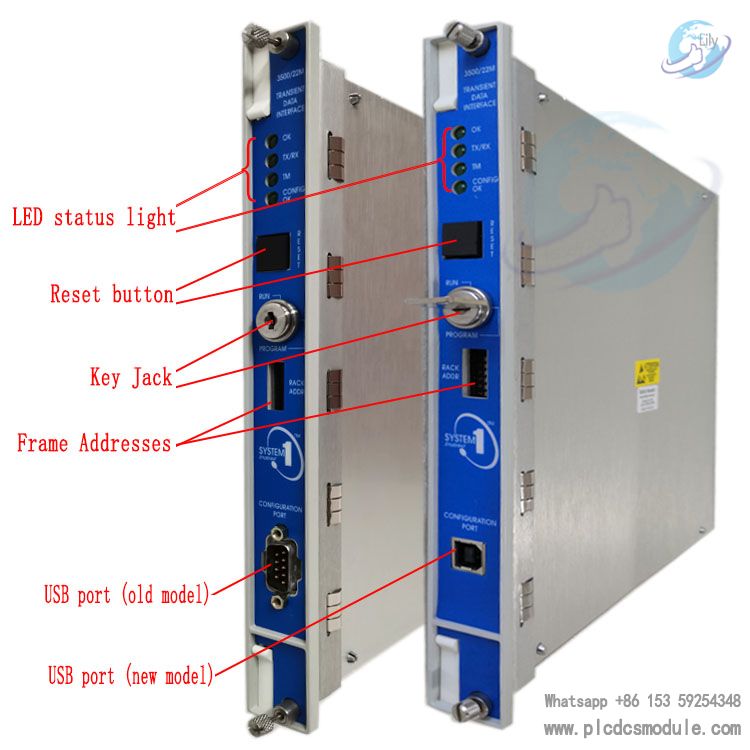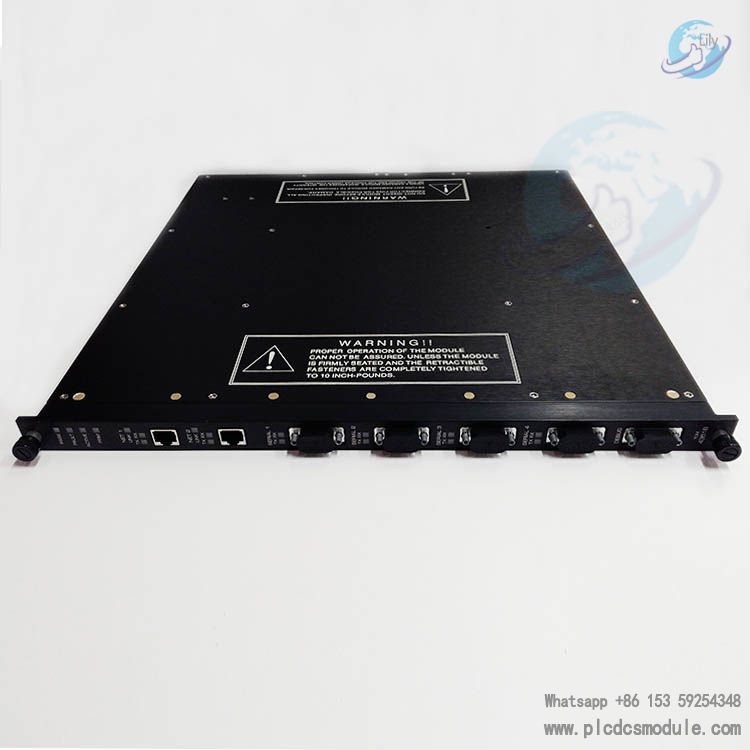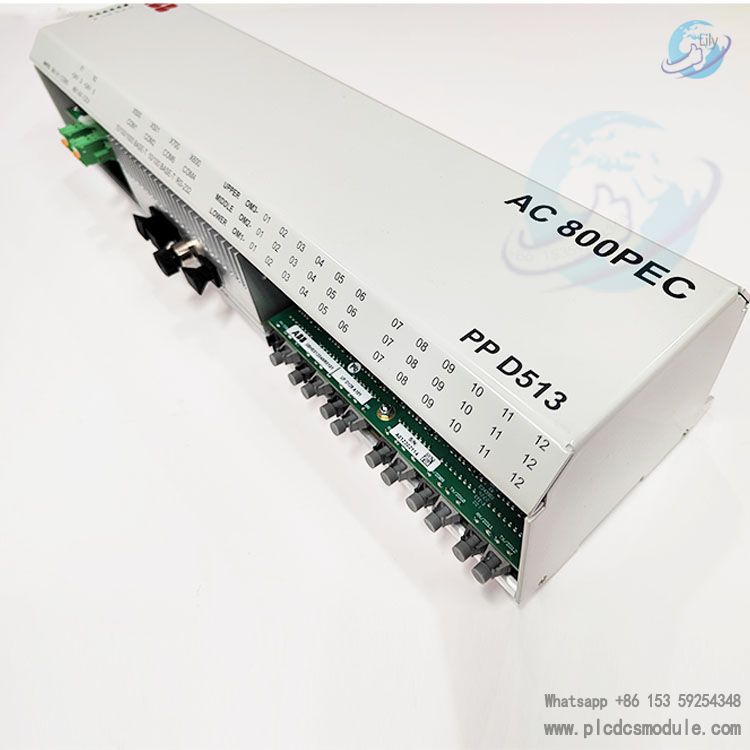


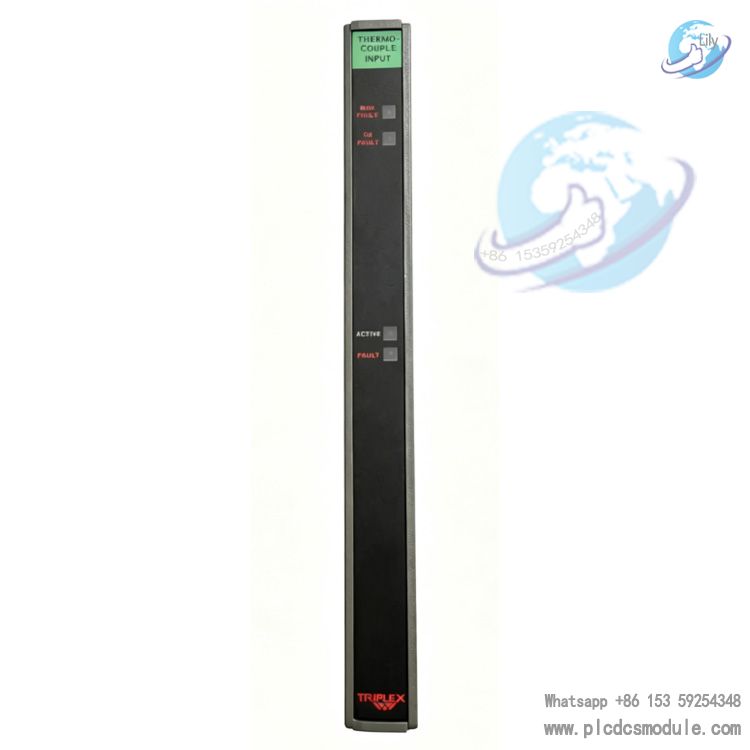
ICS TRIPLEX (formerly Regent/IPLEX brand) T3431A-IM is a 24-channel thermocouple input module designed for industrial automation and safety control systems, belonging to the Regent series safety control product portfolio.
The T3431A-IM supports signal acquisition of multiple thermocouple types, featuring cold junction compensation, linearization processing and high anti-interference performance. It is widely used in process temperature monitoring and safety interlock scenarios in chemical, power, metallurgy and other industries. Compatible with the ICS Triplex Trusted/Regent series safety control systems, it serves as a core unit for high-reliability temperature data acquisition.
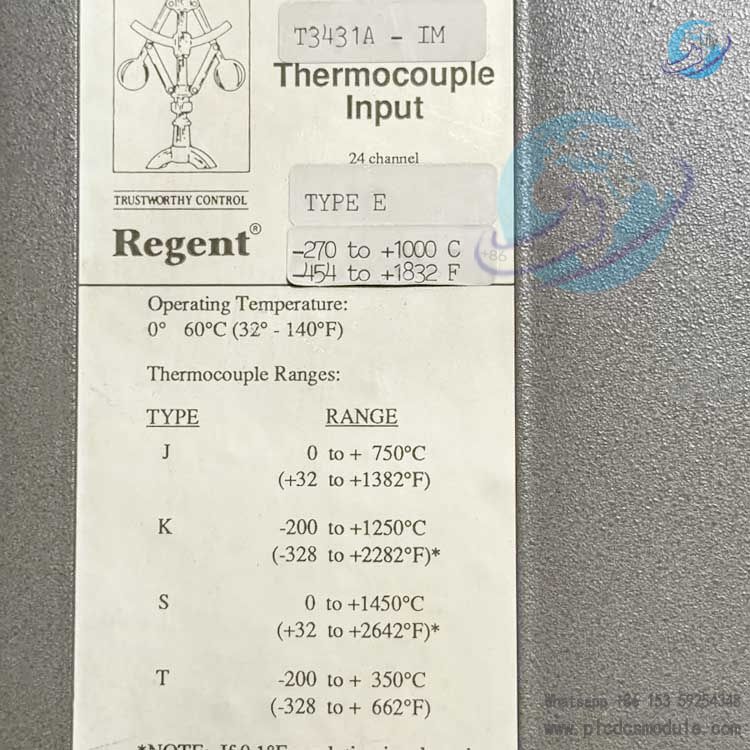
Technical Parameters and Specifications
1. Basic Operating Conditions
Operating Temperature: 0~60℃ (32~140℉)
Number of Channels: 24 channels; thermocouple type can be configured independently in groups of 8 channels.
Electrical Isolation: 2500V isolation between the module and multiplexer (Mux), meeting requirements for on-site anti-interference and safety isolation in industrial applications.
Resolution: Supports display in whole units (1℃/1℉) or tenths (0.1℃/0.1℉). When 0.1℉ resolution is selected, the maximum usable temperature limit is +1638.7℉.
Anti-Interference Characteristic: Built-in 50/60Hz power frequency filter to effectively suppress industrial on-site power interference.
Cold Junction Compensation: Integrated cold junction compensation function automatically corrects the influence of ambient temperature on thermocouple measurement accuracy.
Linearization Processing: Built-in nonlinear curve compensation algorithms for multiple thermocouple types to ensure measurement precision.
Thermocouple Fault Detection: Supports downscale-driven detection of thermocouple wire break faults for rapid identification of signal abnormalities.
Input Protection: Withstands up to 120V RMS overvoltage between terminals.Typical differential input resistance: 2MΩTypical input-to-chassis ground resistance: 1.1MΩTypical bias current: 100nA
2. Supported Thermocouple Types and Measuring Ranges
| Thermocouple Type | Measuring Range (℃) | Measuring Range (℉) |
|---|---|---|
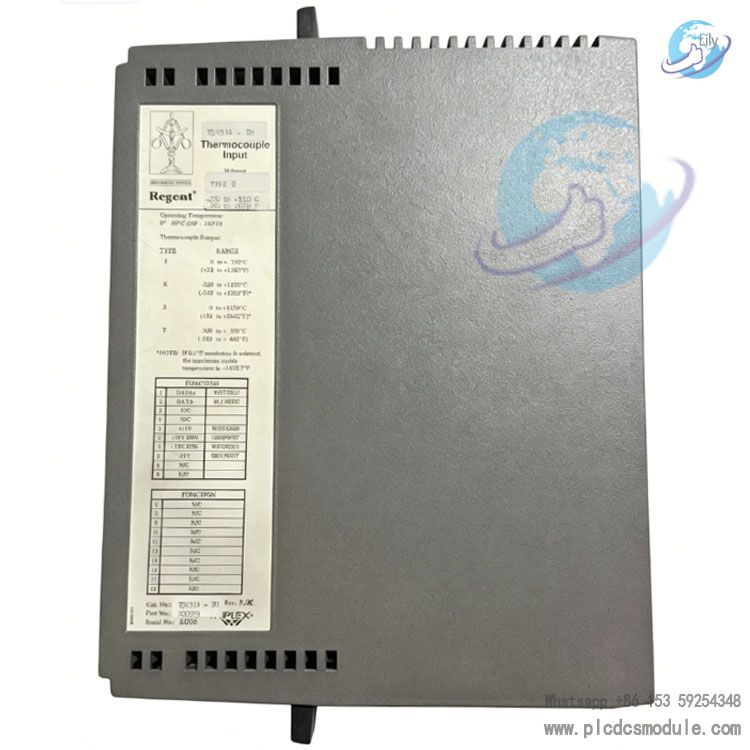
| TYPE J | 0 ~ +750℃ | +32 ~ +1382℉ |
| TYPE K | -200 ~ +1250℃ | -328 ~ +2282℉ |
| TYPE S | 0 ~ +1450℃ | +32 ~ +2642℉ |
| TYPE T | -200 ~ +350℃ | -328 ~ +662℉ |
| TYPE E (Module Preset) | -270 ~ +1000℃ | -454 ~ +1832℉ |
3. Terminal Definition and Wiring Instructions
Module terminals are defined by functional partition. The main wiring terminals are as follows:
| Terminal No. | Function Definition | Wire Color Code |
|---|---|---|
| 1 | DATA+ (Positive Data Signal) | WHT/BLU (White/Blue) |
| 2 | DATA- (Negative Data Signal) | BLU/WHT (Blue/White) |
| 5 | +15V Power Output | WHT/ORN (White/Orange) |
| 6 | +15V Power Return | ORN/WHT (Orange/White) |
| 7 | -15V Power Return | WHT/GRN (White/Green) |
| 8 | -15V Power Output | GRN/WHT (Green/White) |
| 3/4、A/B、C/D、9-16 | Not Connected (N/C) | — |
Product Features and Advantages
Flexible Channel ConfigurationThe 24 channels can be configured for different thermocouple types independently in groups of 8 channels. A single module supports multiple temperature monitoring requirements, reducing system hardware costs.
High Reliability and SafetyTÜV certified, suitable for non-safety-related input applications in Risk Class 5 safety systems. It supports hot-swap replacement, allowing module maintenance without system shutdown and ensuring production continuity.
Remote Signal CompatibilitySupports remote terminal wiring up to 50 feet (approximately 15 meters), meeting long-distance signal transmission requirements in industrial sites and minimizing signal attenuation.
Automatic Calibration and CompensationBuilt-in automatic calibration algorithms, combined with cold junction compensation and linearization processing, maintain long-term measurement accuracy without manual intervention.
Strong Anti-Interference CapabilityIntegrated 50/60Hz filter circuitry together with high-isolation design effectively suppresses electromagnetic interference, power supply fluctuations and other harsh industrial site conditions.
Frequently Asked Questions (FAQ)
Q1: Which thermocouple types does the T3431A-IM module support? How to configure them?A: The module natively supports four standard thermocouple types: J, K, S and T; this model is preset to Type E. Configuration is performed via three jumpers Bit4 / Bit2 / Bit1 on the multiplexer (Mux), set in groups of 8 channels. The temperature unit (℃ or ℉) can also be selected by jumper settings.
Q2: What are the maximum operating temperature and resolution limit of the module?A: The module operating temperature range is 0~60℃. The maximum measurable temperature depends on the thermocouple type; for Type S, the upper limit reaches +1450℃. When the high-resolution mode of 0.1℉ is selected, the maximum usable temperature for Type K and S is +1638.7℉. Temperatures beyond this range require switching to the 1℉ unit mode.
Q3: How to wire the power terminals? Is an external power supply required?A: Terminals 5 and 6 form the +15V power loop, while terminals 7 and 8 form the -15V power loop. Power is supplied by the system backplane, and no additional external power is needed. The DATA+/- terminals are communication signal ports between the module and the system, which shall be wired strictly according to the specified wire color codes.
Q4: How does the module respond when a thermocouple wire breaks?A: The module adopts downscale-driven fault detection logic. In case of thermocouple disconnection or signal abnormality, the measured value will drop directly to the lower limit of the range. The system can quickly identify the fault status and trigger corresponding alarm or interlock actions.
Q5: What precautions should be taken for module installation and maintenance?A:① The module supports hot swapping. Ensure field safety interlocks are backed up before replacement.② The remote terminal wiring length shall not exceed 50 feet to avoid signal attenuation.③ Install and operate the module within 0~60℃; keep away from high temperature, humid areas and strong electromagnetic interference environments.④ Inspect terminal wiring regularly to prevent loosening or oxidation, which may affect signal stability.