

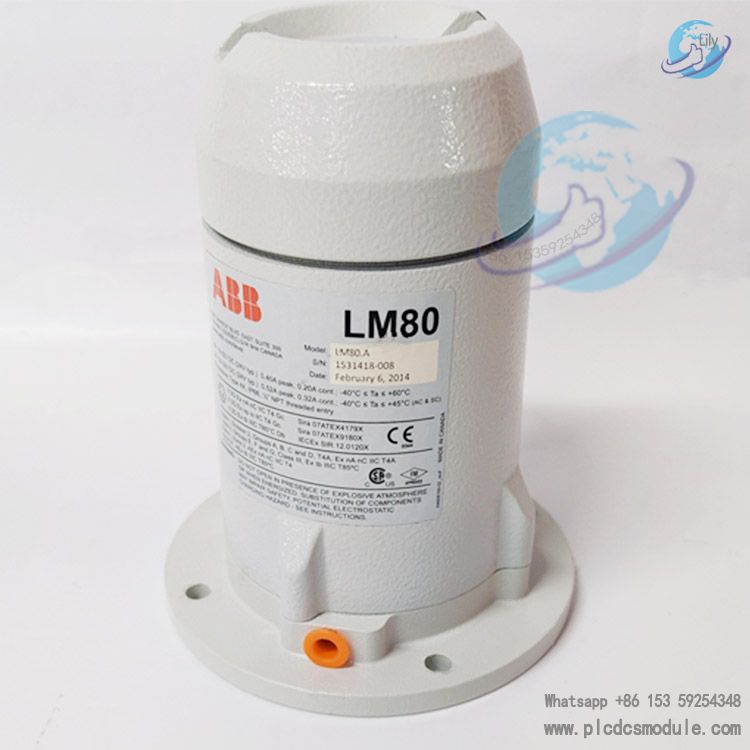
The ABB LM80.A is a high-performance non-contact laser distance level transmitter. Engineered for harsh industrial environments, it adopts high-precision laser time-of-flight measurement technology to deliver long-range and highly accurate monitoring of material level, liquid level and object position.
Integrated with advanced timing control and sophisticated signal processing technologies, the unit features a measuring range up to 100 meters for material and liquid level applications, and 150 meters for positioning tasks. It operates reliably amid dust, steam and intense light interference, serving as a key device for level measurement in industrial process control.
document download

Core Product Advantages
Superior Measuring Accuracy & StabilityAdopting 905 nm Class 1M infrared laser with a beam divergence angle less than 0.3°, the device generates no false echoes. It delivers precise measurements on rough and inclined surfaces, and its performance is unaffected by material angles, vessel shapes or material properties.
Excellent Adaptability to Harsh EnvironmentsFeaturing a robust aluminum housing and IP66 protection rating, it operates stably within a wide temperature range of -40°C to +60°C. An optional heated lens extends the upper temperature limit to +45°C. Equipped with an integrated purge port, it is well suited for environments with heavy dust, high temperature and explosion hazards.
Calibration-Free & Easy DeploymentFactory pre-calibrated, it requires no on-site adjustment after installation. Real physical distance data is available immediately once the laser is aimed at the target. It supports 4-20 mA analog output and relay output, and is fully compatible with mainstream PLC and DCS systems.
Low Maintenance & Long Service LifeWith no moving parts and a dust-proof optical lens design, the transmitter ensures long-term stable operation when used with dedicated dust removal accessories. Routine periodic maintenance is not required under normal operating conditions; only regular lens cleaning is needed.
Flexible Configuration for Diverse ApplicationsFive built-in operating modes are available: Standard, Light Dust, Heavy Dust, Positioning and Custom. Parameters can be quickly configured via the LCD2 handheld terminal or PC to meet requirements of various working conditions.
Key Product Specifications
Electrical CharacteristicsPower supply: 18–32 V DC (typical 24 V DC).Isolated 4-20 mA output, 2 normally open relay outputs, and RS232 communication interface.
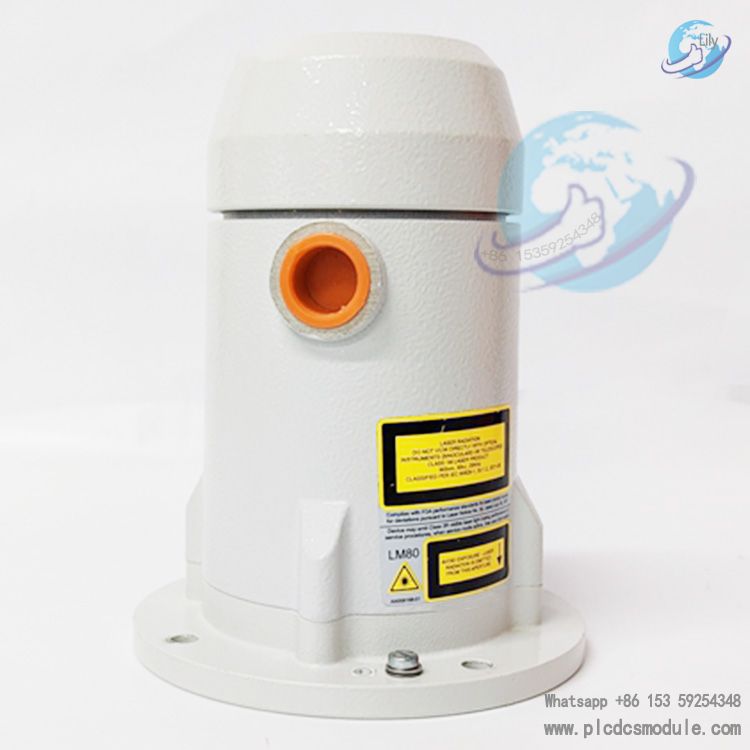
Mechanical CharacteristicsStandard flange mounting with a base diameter of 98.2 mm.Optional 4/6 inch ANSI/DIN universal mounting plates and sanitary clamp connections.
Safety CertificationsCertified with CE, ATEX, IECEx, CSA and FM. Approved for use in Zone 2 hazardous areas.Laser safety class: Class 1M during normal operation; Class 3R when the aiming laser is activated.
Signal ProcessingAdopts variable-gain signal separation. Supports transient obstacle filtering and signal strength monitoring. Built-in fail-safe mode with three states: 3.6 mA output, 21 mA output or hold the last value.
Application Scenarios
Liquid & Slurry MeasurementLevel detection of opaque liquids and slurries in wastewater treatment, chemical solvents, polymers, inks and more. Performs reliably in high-temperature and corrosive environments.
Mobile Equipment PositioningHigh-precision positioning and anti-collision protection for travelling cranes, tripper cars, stacker-reclaimers and other mobile machinery, with a maximum measuring range up to 150 m.
Special Industrial ApplicationsApplicable to reactors (with sight glass), high-temperature hoppers, crushers and port bulk material yards. It serves as an ideal alternative to traditional radar and ultrasonic level meters.
Supporting Accessories
| Accessory Type | Model | Description |
|---|---|---|
| Dust Removal Accessory | P801 Purge Pipe | Prevents dust accumulation on the lens. Supports air purging at 3–5 psi, made of 304 stainless steel. |
| High-temperature Accessory | P802 Cooling Pipe | Isolates high-temperature process surfaces via convection heat dissipation, for installation on high-temperature vessels. |
| Mounting Components | F804/F806 Flange, A800 Bracket, S800 Swivel Flange | Compatible with ANSI/DIN flanges. Allows 180° adjustable installation for accurate aiming. |
| Communication Accessories | LCD2 Handheld Terminal, USBR RS232-to-USB Cable | On-site parameter configuration, commissioning and diagnostics, no PC required. |
| Explosion-proof Accessories | GCK Explosion-proof Cable Gland, GC1 Inch-to-Metric Adapter | Ensures explosion safety of electrical connections in hazardous areas. |
Installation & Maintenance
1. Installation Guidelines
- Mounting Position: Install vertically facing the measured material surface with no obstacles in the laser beam path. Avoid material falling zones for solid applications, and keep the beam perpendicular to the liquid surface as much as possible.
- Wiring: Use shielded cables. Route the 4-20 mA circuit and power cables separately. Implement reliable earthing with 16AWG (1.5 mm²) ground wire to eliminate electromagnetic interference.
- Dusty Environments: The P801 purge pipe is mandatory. Connect 3–5 psi instrument air for continuous purging in heavy dust conditions to keep the lens clean.
- Commissioning Steps: After power-on, set the 4-20 mA range (4 mA for full/empty level, 20 mA for empty/full level), operating mode and fail-safe mode via LCD2 terminal or PC.
2. Maintenance Rules
- Routine Maintenance: No periodic overhaul is required due to the absence of moving parts. Inspect and clean the lens every 3 to 6 months: blow off dust with instrument air, and remove stubborn stains with alcohol and professional optical wipes.
- Troubleshooting
- No display: Check 24 V DC power supply and wiring connections.
- Fluctuating readings: Clean the lens, switch to Heavy Dust mode and verify earthing.
- Loss of signal: Check for beam blockage and adjust the aiming angle.
- Precautions: Do not open or modify the device; return to the factory for repairs. Never aim the laser directly at the sun. Opening the cover while powered on is strictly prohibited in hazardous areas.
FAQ
1. What are the advantages of LM80.A over radar and ultrasonic level meters?
- Compared with radar level meters: No false echoes, superior resistance to dust and steam, higher accuracy for long-distance measurement, and immunity to material dielectric constant. It works perfectly for low-dielectric materials such as plastic pellets and dry dust.
- Compared with ultrasonic level meters: Longer measuring range (100 m vs 30 m), better temperature resistance, no dead zone, and immunity to strong light and steam. It delivers far more stable performance in high-temperature environments.
2. Will measurement accuracy be compromised in heavily dusty environments?No. The LM80.A is equipped with dedicated Light Dust and Heavy Dust modes featuring enhanced filtering and variable gain technology. Combined with the P801 purge pipe and continuous air purging, the laser can penetrate dense dust layers for stable measurement. Field tests in coal and cement silos show the measurement error is within ±5 mm.
3. Is the red aiming laser harmful to human health during startup?It is safe. The Class 3R aiming laser (635 nm, <2 mW) is activated for 2 minutes after startup; simply avoid direct eye exposure. The device automatically switches to invisible Class 1M infrared laser (905 nm) for normal operation. Direct viewing with optical telescopes poses minor risks, while daily use is completely safe.
4. Can it measure high-temperature molten materials directly?Direct measurement is not recommended. The standard model withstands a maximum ambient temperature of +60°C. For high-temperature applications, use the P802 cooling pipe together with the optional heated lens (AC/SC). Measure molten materials such as molten plastics and contents of high-temperature reactors indirectly through sight glasses, suitable for temperatures above +200°C.
5. How to solve fluctuating 4-20 mA signals?
- Clean the optical lens to remove dust and stains.
- Ensure reliable earthing, single-end grounding for shielded cables, and keep cables away from high-voltage lines.
- Switch to Heavy Dust mode and extend the filter delay time.
- Calibrate the 4-20 mA output via LCD2 terminal or PC to match readings on the PLC.
6. Will parameters be lost after power failure?No. All configured parameters including measuring range, operating modes and fail-safe settings are stored in non-volatile memory and retained permanently after power cuts. Parameters can be exported via PC for quick batch configuration when replacing units.