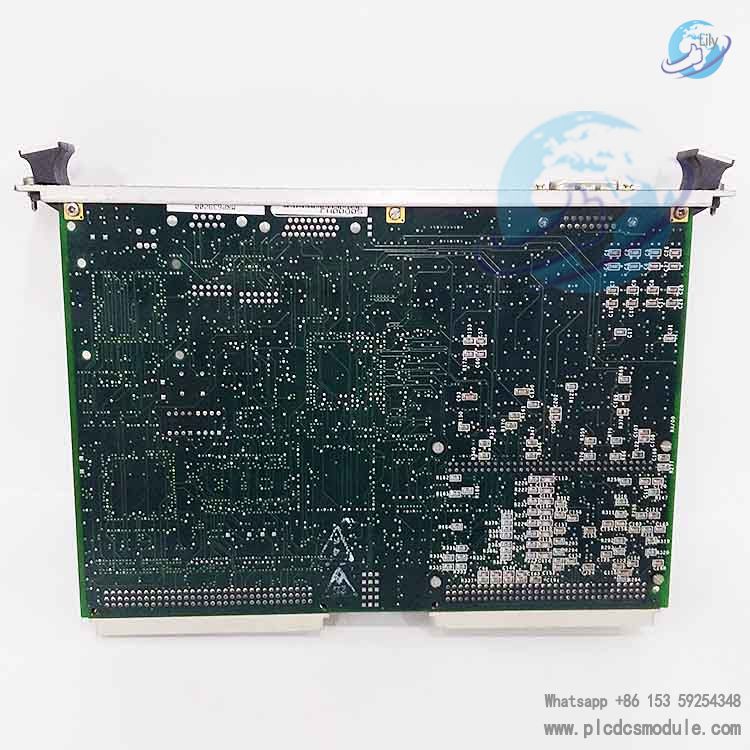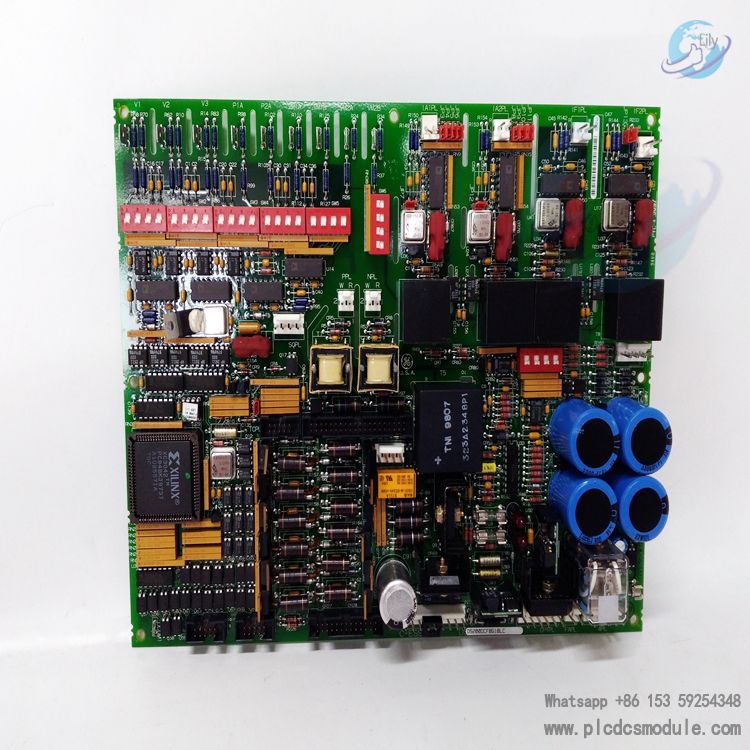


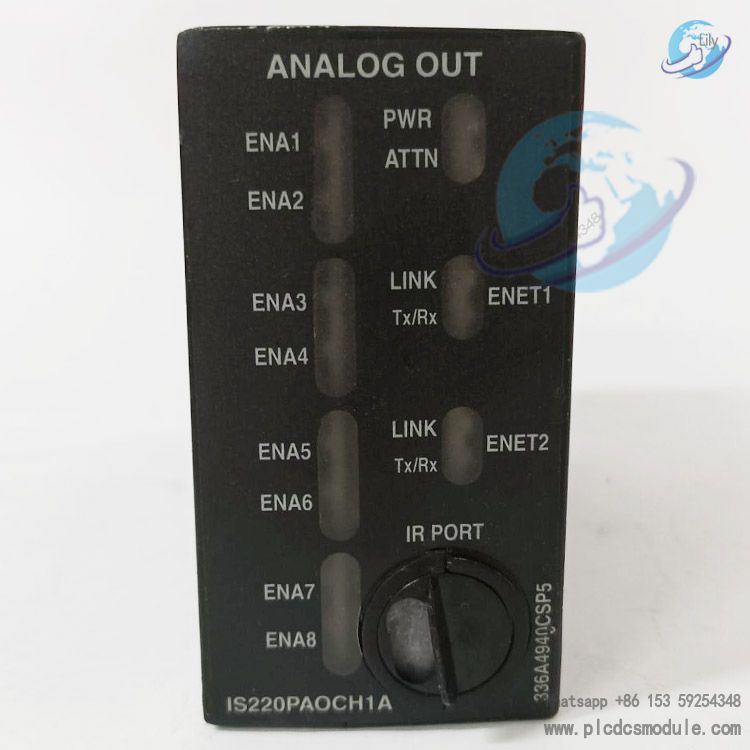
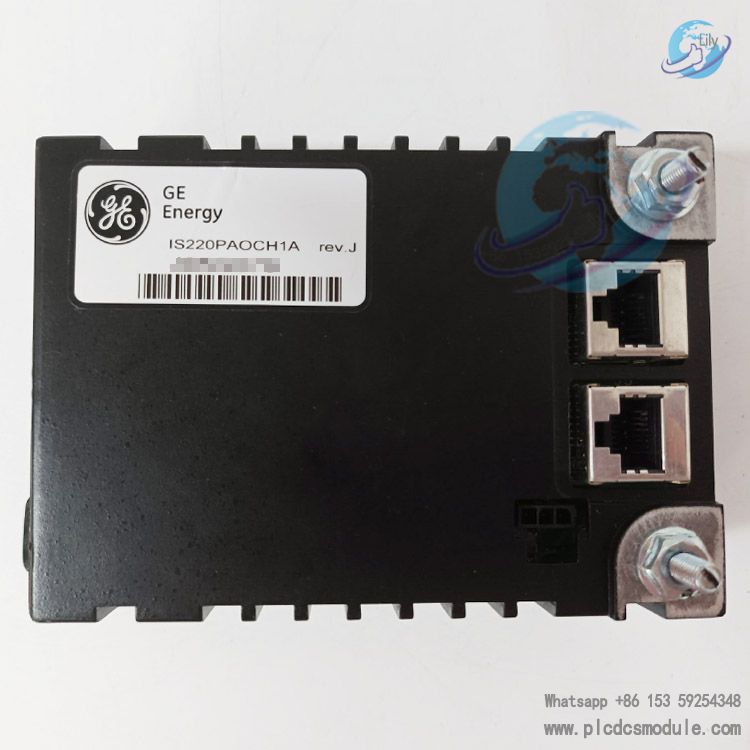
IS220PAOCH1A 363A4940CSP5 is an 8-channel Isolated Analog Output Module (PAOC) under GE Vernova Mark VIe Speedtronic system. It is specially designed for high-precision control of heavy-duty power equipment such as gas turbines and steam turbines. Its core function is to convert digital controller signals into 4-20mA/0-10V analog signals to drive actuators including valves, servos and inverters, serving as a core I/O component in the critical control links of power generation, oil and gas industries.
Core Product Advantages
Ultra-high Precision and Stability16-bit DAC resolution with accuracy of ±0.1% FS (Full Scale) over a wide temperature range of -30℃ to +65℃. Extremely low temperature drift meets the control requirements of precision actuators such as gas turbine fuel valves and guide vane servos.
Full-link Redundancy DesignSupports TMR triple modular redundancy and dual Ionet Ethernet (100 Mbps). Primary link fault switching ≤ 0.5 ms with no data loss. Critical circuits (DAC, power supply) adopt redundant backup, with MTBF ≥ 110,000 hours, ideal for high-reliability continuous operation scenarios.
Excellent Adaptability to Harsh EnvironmentsOperating temperature: -30℃ ~ +70℃; vibration resistance up to 5g (10–500 Hz); EMI compliance with EN 61326-1. Suitable for high-temperature, high-vibration and strong-interference industrial environments such as power plants and oil & gas facilities.
Hot-Swap & Easy MaintenanceSupports online hot swapping for module replacement without system shutdown. Equipped with 4 status LEDs (Power/Attention/TxRx/Link) for visual fault indication, greatly reducing maintenance difficulty.
Deep Native System IntegrationSeamlessly compatible with Mark VIe controllers (e.g., IS220PPROH1A). Supports one-click configuration and automatic firmware download via ToolboxST software. Compatible with TBAOH1C terminal base for plug-and-play deployment.
Key Technical Specifications
| Characteristic | Parameter | Application Scenario |
|---|---|---|
| Channel Configuration | 8 isolated output channels; each channel software-selectable 4-20mA / 0-10V | Gas turbine fuel valve control (4-20mA), boiler feed water pump variable frequency speed regulation (0-10V) |
| Load Capacity | Max. 900Ω per channel (4-20mA mode) | Long-distance signal transmission (≤1km), compatible with high-impedance actuators |
| Response Time | Scan cycle 5ms, signal settling ≤10ms | Dynamic load adjustment of steam turbines, rapid speed regulation of reactor vessels |
| Isolation Rating | 1500VAC between channels, 2500VAC channel-to-ground | High-interference environments (near inverters and high-voltage equipment), prevents signal crosstalk |
| Power Supply | 22.5~28VDC (nominal 24VDC) | Industry standard power supply, compatible with plant UPS DC bus |
| Dimension / Weight | 178mm×101mm×76mm, 1.27kg | Standard rack mounting, saves control cabinet space |
Operation Guide
1. Hardware Installation
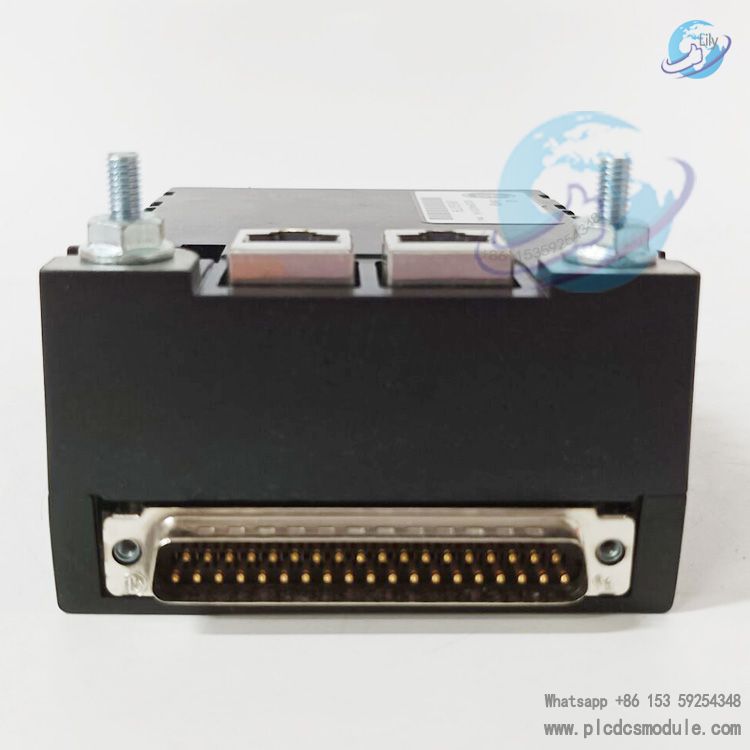
Power off the system first, align the module with the Mark VIe rack slot, and insert it smoothly.Tighten the fixing bolts on both sides of the Ethernet port to ensure reliable connection with the TBAOH1C terminal base (DC-37 pin interface).Connect dual Ionet Ethernet cables to the controller, apply 24VDC power, and perform power-on self-test. Steady-on Power LED indicates normal status.
2. Software Configuration
Launch ToolboxST and scan to identify the module (Model: IS220PAOCH1A, firmware auto-matched).Channel configuration: Select output type (4-20mA / 0-10V), and set measurement range and alarm thresholds (e.g., open-circuit / short-circuit alarm).Redundancy configuration: Bind three modules under TMR mode and set data voting logic; configure primary and standby IPs for dual-network redundancy and enable automatic switching.Download the configuration to the module, restart to take effect, and monitor channel status via LED indicators and software.
3. Commissioning & Maintenance
No-load commissioning: Output 50% signal, measure terminal voltage/current with a multimeter. A precision deviation within ±0.1% is deemed qualified.On-load test: Connect the actuator and adjust across full scale to confirm no jitter or response lag.Routine maintenance: Check LED status regularly and view fault logs via ToolboxST. Replace faulty modules via hot-swap without system shutdown.
FAQ
1. Power LED does not light up after module power-on?
Check whether the 24VDC power supply is normal (voltage range: 22.5~28VDC) and verify correct power polarity connection.Check for loose connection between the module and terminal base; reinsert the module and tighten the fixing bolts.If the fault persists, replace the module; the cause is most likely an internal power circuit failure.
2. Large deviation of output signal (>±0.5%)?
Confirm the channel type is correctly configured (4-20mA / 0-10V) and the range matches the actuator.Verify the load resistance is within specification (≤900Ω in 4-20mA mode); use thicker cables for long-distance transmission.If the ambient temperature exceeds -30℃~+65℃, improve heat dissipation or adjust the installation position.
3. Redundancy switching failure or packet loss?
IP conflict in dual network configuration; ensure primary and standby IPs are in the same network segment with no duplication.Damaged or poorly contacted Ethernet cable; replace with shielded network cable and re-seat the RJ45 interface.Inconsistent firmware versions among the three modules under TMR mode; unify and upgrade firmware via ToolboxST.
4. Module overheating alarm (Attention LED flashing)?
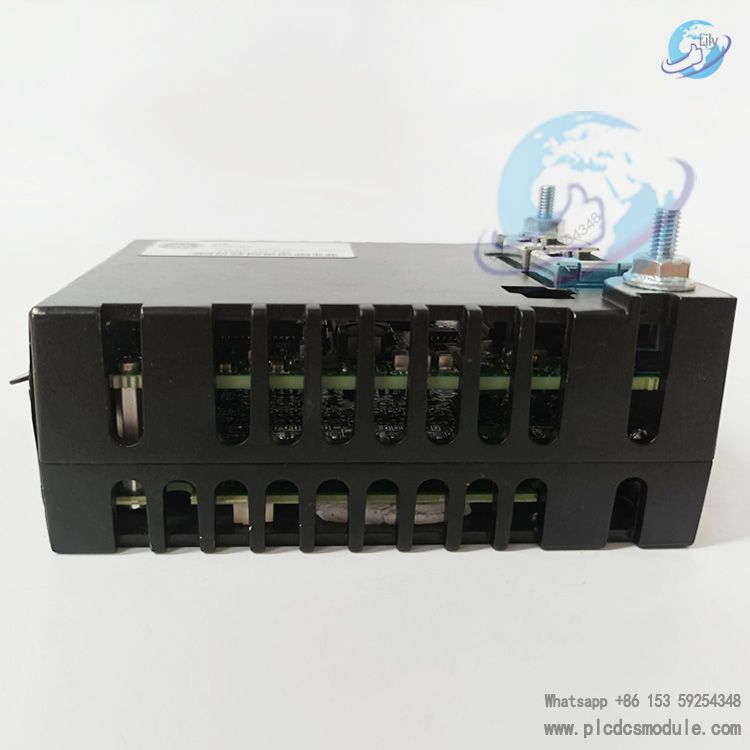
Poor heat dissipation in the control cabinet with ambient temperature over 70℃; install additional fans or air conditioning.Modules are installed too densely with spacing less than 20mm, hindering air circulation; rearrange the rack layout.Short circuit in output channel causing excessive load current; troubleshoot short-circuit faults in actuators and wiring.
5. Is it compatible with non-GE controllers?
Not recommended. The module is natively designed for the Mark VIe system and provides no communication protocol support for third-party controllers. Forced compatibility requires an additional gateway, with stability and accuracy not guaranteed.