

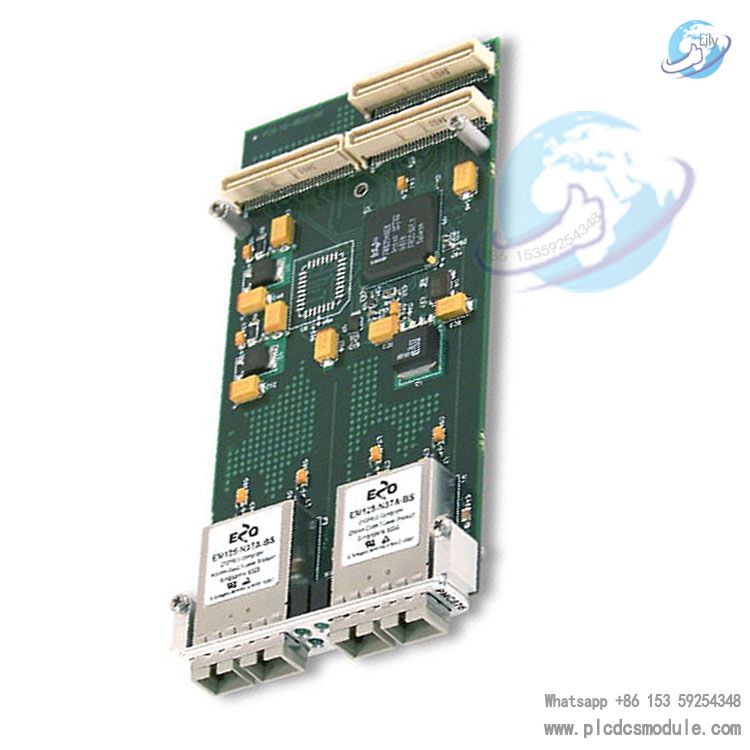
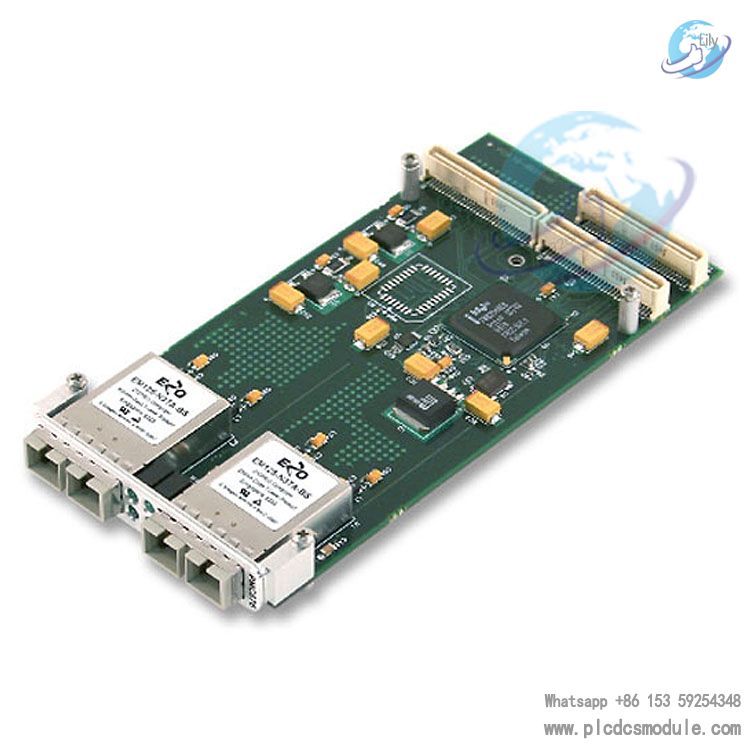
The PMC676RCLC is a dual-port fiber Gigabit Ethernet PMC network interface card developed by GE Fanuc that complies with RoHS Directive 2002/95/EC. Part of the PMC676RC product series, it features 1000Base-SX fiber LC interfaces and adopts a hardware architecture built around the Intel 82546 dual-channel Gigabit Ethernet controller. It is engineered to deliver high-speed and stable fiber communication links for embedded ruggedized computers and industrial real-time control equipment.
Each port of the GE PMC676RCLC is equipped with an independent DMA processing unit and a 64KB deep FIFO buffer, which significantly reduces PCI-X bus overhead and ensures lossless transmission at full bandwidth. Derivative models within the same product line include copper interface variants, SC fiber versions, the 4-port PMC677RCLC, and the PCI mezzanine card RM676RCLC, alongside other editions. Featuring compact LC fiber connectors, wide-temperature operation and full cross-system driver compatibility, the GE PMC676RCLC is widely deployed in real-time data exchange applications such as military avionics, power DCS systems and rail transit.

Technical Specifications
Bus & Physical Specifications
Form Factor: Single-slot PMC Mezzanine CardBus Support: 64-bit 33/66 MHz PCI, 133 MHz PCI-X; compatible with 3.3 V / 5 V PCI signaling standardsPhysical Interfaces: Dual LC fiber interfaces, 1000Base-SX multimode fiber; custom 1000Base-LX single-mode optical modules available as an optionPower Consumption: Total 6 W; 0.9 A @ 3.3 V, 0.6 A @ 5 VService Life: MTBF of 245,000 hours at 25 °C ambient temperature
Environmental Specifications
Standard Operating Temperature: 0 °C ~ +60 °C; extended temperature variant: -20 °C ~ +70 °CStorage Temperature: -40 °C ~ +85 °CHumidity: 5% ~ 95% non-condensing (operating and storage)
Ethernet Hardware Specifications
Port Configuration: 2 independent Gigabit fiber channels, full-duplex transmissionBuffer Allocation: Independent 64 KB transmit/receive FIFO buffer per portController Chip: Intel 82546 dual-port Gigabit Ethernet MAC controllerFrame Support: Jumbo Frame, IEEE 802.1Q VLAN (4096 tag groups)
LED Definition (GE PMC676RCLC)
Two LEDs per port: LNK (Link) indicator and ACT (Activity) indicatorSteady LNK light: Valid fiber link establishedFlashing ACT light: Data transmit/receive traffic present on the port
Functional Advantages
Low Bus Overhead Transmission Architecture
Each network port of the GE PMC676RCLC is equipped with an independent DMA engine and a large 64KB FIFO buffer for smoothing burst data streams. It drastically reduces PCI-X bus overhead under sustained full Gigabit load, meets the low-latency communication requirements of real-time control systems, and avoids occupying CPU computing resources.
Comprehensive Hardware Offloading Acceleration
Onboard hardware TCP checksum offload and multi-mode address filtering are implemented, including precise matching for 16 unicast/multicast addresses and a 4096-bit multicast hash filter. Promiscuous unicast and multicast receiving modes are supported. Integrated SNMP and RMON statistical counters enable traffic statistics and packet filtering without CPU intervention, greatly freeing up computing power of embedded hosts.
Industrial-Grade Stable Fiber Transmission
LC fiber media completely eliminates electromagnetic interference and ground loop issues in industrial sites. It supports two topologies: point-to-point direct connection and switch networking, with no crossover cables required. SX multimode and LX single-mode optical modules are available for different transmission distances, making the card suitable for power plants, radar systems, vehicle-mounted control systems and other environments with intense electromagnetic interference.
Native Driver Compatibility with Full Operating Systems
GE Fanuc provides official drivers for the GE PMC676RCLC, covering embedded and commercial operating systems including VxWorks, LynxOS, Solaris, Windows NT, and Linux 2.4/2.6 series. The drivers feature deep integration with system LAN protocol stacks, allowing seamless integration into existing embedded platforms without extra development work.
Customizable Function Expansion
Optional firmware includes -S Solaris OBP network boot firmware and -P PXE remote boot firmware. Acrylic or polyurethane conformal coating and WT extended-temperature variants can be customized to satisfy long-term stable operation requirements of military and outdoor industrial equipment.
RoHS-Compliant Standardized Design
The complete GE PMC676RCLC unit complies with the EU RoHS Directive and contains no hazardous heavy-metal components. It is applicable to equipment projects exported to the EU, and complete material environmental test reports can be provided.
Product Features
Hardware Architecture Features
The GE PMC676RCLC adopts a single Intel 82546 dual-channel controller solution. The two network ports are fully physically isolated with no bandwidth contention between ports. Independent EEPROM and LED control circuits are integrated. Upon power-up, the board automatically detects optical module types and link statuses; port status can be read without software initialization.
Network Protocol Features
Native support for IEEE 802.1Q VLAN tag insertion, stripping and packet filtering. Fully compliant with all standard Gigabit Ethernet protocols with automatic full-duplex negotiation. The fiber variant removes MDI/MDIX switching constraints to simplify cabling work.
Mechanical & Protection Features
Standard single-slot PMC form factor, compatible with all host carrier boards conforming to PMC 2.0 specifications. Optional conformal coating offers protection against dust, moisture and mild chemical corrosion. Components meet specified ESD protection standards; anti-static installation guidelines are provided.
Optional Suffix Codes for Configuration
Suffix identifiers apply to all models of the series:
- -S: Solaris OBP remote network boot
- -P: PXE network boot
- -CC: Polyurethane conformal coating
- -CCA: Acrylic conformal coating
- -WT: Wide-temperature operating specification
Application Fields
Military Avionics Equipment
Airborne ruggedized computers, radar signal processing enclosures, shipboard embedded control platforms. Leveraging the anti-interference performance of fiber optics, the GE PMC676RCLC enables real-time data synchronization among multiple devices and high-speed transmission of radar imagery.
Power & Energy DCS Systems
Distributed control systems for thermal power, wind power and transformer substations. Dual fiber ports build redundant communication links to deliver stable Gigabit data exchange between field instruments, main control units and SCADA monitoring platforms.
Rail Transit On-Board Control
Train TCMS control systems and on-board signal processing hosts. The wide-temperature GE PMC676RCLC withstands extreme temperature fluctuations and strong electromagnetic fields inside carriages to ensure low-latency transmission of train control commands.
Real-Time Industrial Automation Control
High-end CNC equipment, robot cluster controllers, test and measurement devices. The low-latency DMA architecture facilitates high-speed transmission of motion control commands and sensor sampling data.
Embedded Research & Test Platforms
Particle accelerator control systems, automatic inspection equipment and simulation test enclosures. Compatible with real-time operating systems such as VxWorks and LynxOS to support high-precision synchronous data acquisition.
Compatible Hardware Models
1. Compatible Host Carrier Boards (Motherboards with PMC Slots)
VMICPCI-7696 and V7768-320001 series 3U/6U rugged embedded CPU carrier boards come equipped with standard PMC expansion slots and support direct installation of the GE PMC676RCLC.
2. PCI Adapter Accessories
GE PMC239 PMC-to-PCI converter adapter. Industrial PCs with standard PCI slots but no PMC slots can operate the GE PMC676RCLC via the PMC239 adapter.
3. Supporting Transmission Media
LC multimode 1000Base-SX fiber patch cords, LC single-mode LX fiber patch cords (for GE PMC676RCLC units with custom optical modules); fiber switches and Gigabit fiber media converters.
4. Co-located Expansion within Chassis
The GE PMC676RCLC can be installed in the same chassis alongside GE PMC motion control cards and PMC 1553 bus communication cards to build an integrated embedded control platform, where the GE PMC676RCLC handles external Gigabit fiber data exchange.
FAQ
Q1: What are the core differences between the GE PMC676RCLC and ordinary commercial Gigabit network adapters?A1: The GE PMC676RCLC is a PMC mezzanine card dedicated to industrial embedded applications. It adopts independent 64KB FIFO buffers and hardware DMA to reduce CPU utilization. The fiber interface delivers immunity against industrial electromagnetic interference. It supports wide-temperature operation, conformal coating, and drivers for real-time operating systems, making it suitable for harsh environments such as military and power systems. Commercial network cards do not adopt the PMC form factor, lack compatibility with real-time operating systems, and cannot withstand extreme temperatures and heavy electromagnetic interference.
Q2: Does the GE PMC676RCLC support remote network boot?A2: Yes. Add suffix -S during ordering for Solaris OBP boot; add suffix -P for universal PXE network boot. The corresponding boot firmware is preloaded at the factory. Enable LAN Boot in the host BIOS/OBP menu to boot the system via the GE PMC676RCLC.
Q3: How to troubleshoot if the LNK link LED of the fiber port on GE PMC676RCLC stays off?
A3:
Step 1: Check whether the end faces of fiber patch cords are contaminated, bent or damaged.
Step 2: Verify that the remote optical module complies with the 1000Base-SX standard.Step 3: Power off the system, re-seat the GE PMC676RCLC, and ensure full contact of the PMC connector.Step 4: Replace the fiber cable for cross-testing to rule out cable faults.Q4: Does the GE PMC676RCLC support packet redundancy and link backup?A4: No built-in hardware redundancy switching chip. Link backup can be implemented via OS-based link aggregation and dual-port redundancy protocols. With two independent fiber channels, the GE PMC676RCLC is ideal for constructing dual redundant communication architectures.
Q5: What fiber transmission distances does the GE PMC676RCLC support?A5: The standard 1000Base-SX multimode optical module supports transmission up to 550 meters. For long-distance communication of several kilometers, order the customized GE PMC676RCLC equipped with LX single-mode optical modules.
Q6: Can the GE PMC676RCLC operate stably at -20°C low temperature?A6: The standard version operates within 0°C ~ +60°C. Select the wide-temperature customized variant with the -WT suffix for low-temperature applications, supporting continuous operation from -20°C to +70°C.
Q7: Can the GE PMC676RCLC work with both Solaris and VxWorks systems?A7: There are no hardware-level OS restrictions; functionality depends entirely on drivers. GE Fanuc provides separate driver packages for both operating systems. The GE PMC676RCLC works normally once the matching driver is installed after switching the host operating system.
Recommended Models of the Same Series
PMC676RCLC Dual-port LC Fiber Gigabit PMC Network CardPMC676RCSC Dual-port SC Fiber Gigabit PMC Network CardPMC676RCTX Dual-port RJ45 Copper Gigabit PMC Network CardPMC677RCLC Quad-port LC Fiber Gigabit PMC Network CardPMC677RCTX Quad-port RJ45 Copper Gigabit PMC Network CardRM676RCLC Dual-port LC Fiber PCI Mezzanine Network CardRM676RCSC Dual-port SC Fiber PCI Mezzanine Network CardRM676RCTX Dual-port RJ45 Copper PCI Mezzanine Network CardRM677RCLC Quad-port LC Fiber PCI Mezzanine Network CardRM677RCTX Quad-port RJ45 Copper PCI Mezzanine Network CardPMC676RCLC-S Dual-fiber PMC Network Card with Solaris BootPMC676RCLC-P Dual-fiber PMC Network Card with PXE BootPMC676RCLC-CC Dual-fiber PMC Network Card with Conformal CoatingPMC239 PMC-to-PCI Adapter Board