

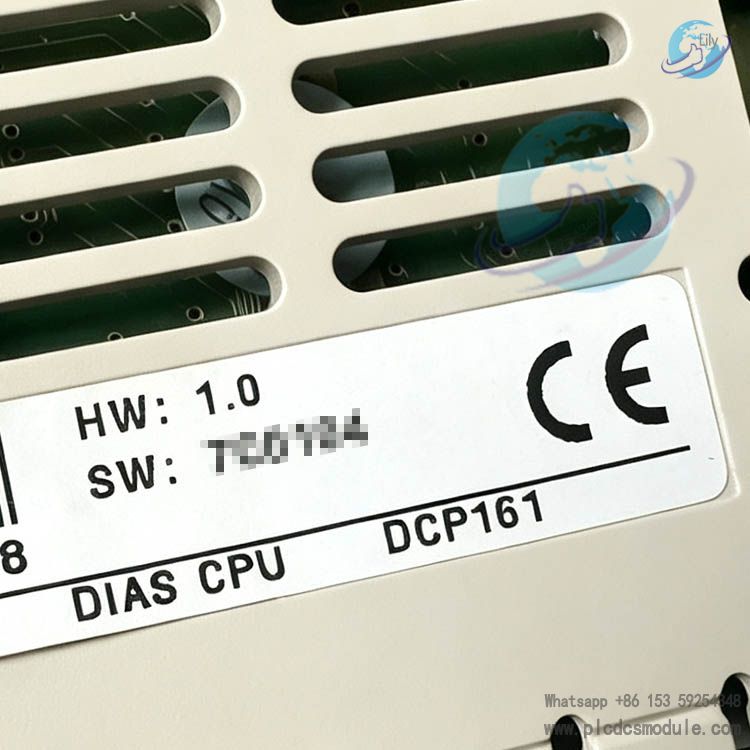
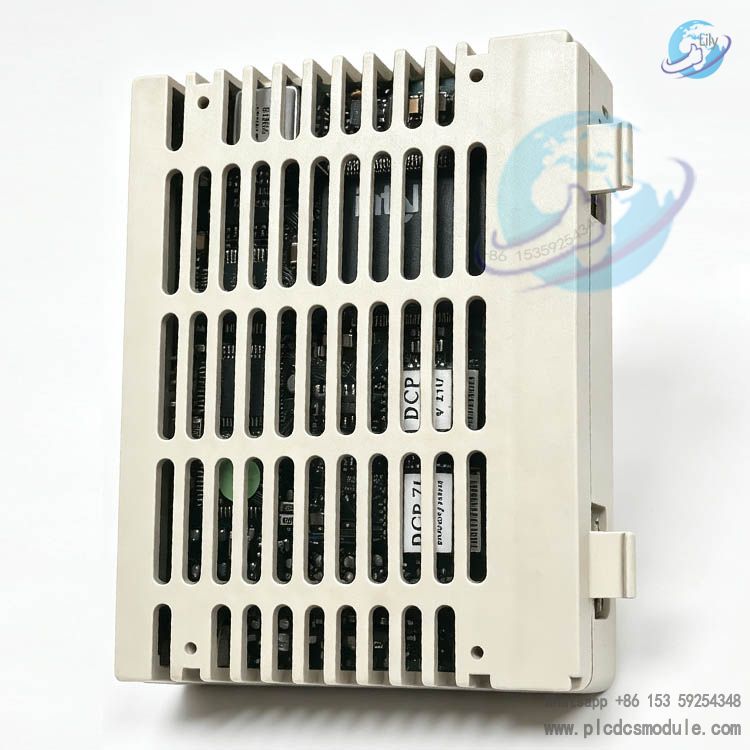
SIGMATEK DCP161 DIAS CPU Module
1. Product Overview
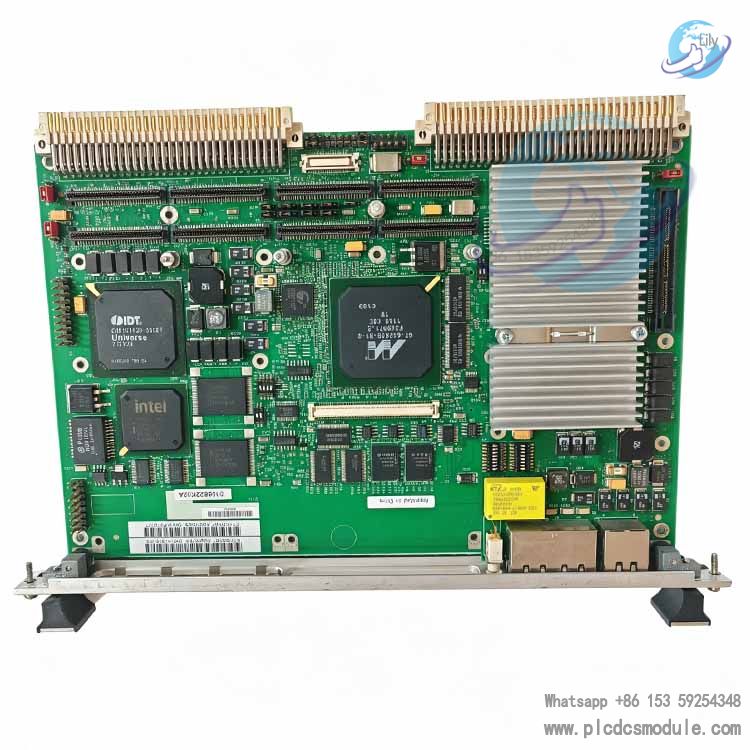
Fully compatible with LASAL programming software, the module supports offline logic programming, real-time online debugging, and accurate fault diagnosis. With stable computing performance, intuitive hardware status indicators, and superior industrial anti-interference capability, the SIGMATEK DCP161 is widely applied in legacy small automated equipment retrofits, forming machinery, and standalone packaging machine control systems.
2. Core Advantages & Key Features
- Ultra-Fast Instruction Execution: Features a minimum 0.094μs single-cycle instruction speed and a typical 0.3μs execution time, achieving zero delay for short-cycle machine control logic to ensure high-response equipment operation.
- Multi-Bus Integrated Communication: Integrated CAN bus supports multi-machine networking; dual serial ports connect HMI, upper computers, and sensor terminals. The RS2 port supports differential communication for stable long-distance wiring transmission.
- Long-Term Offline Data Retention: Equipped with a standard RENATA CR2450N lithium battery, it retains system programs and operation variables for up to 3 years without power supply. Battery replacement must be completed in power-on status to avoid data loss (annual replacement recommended).
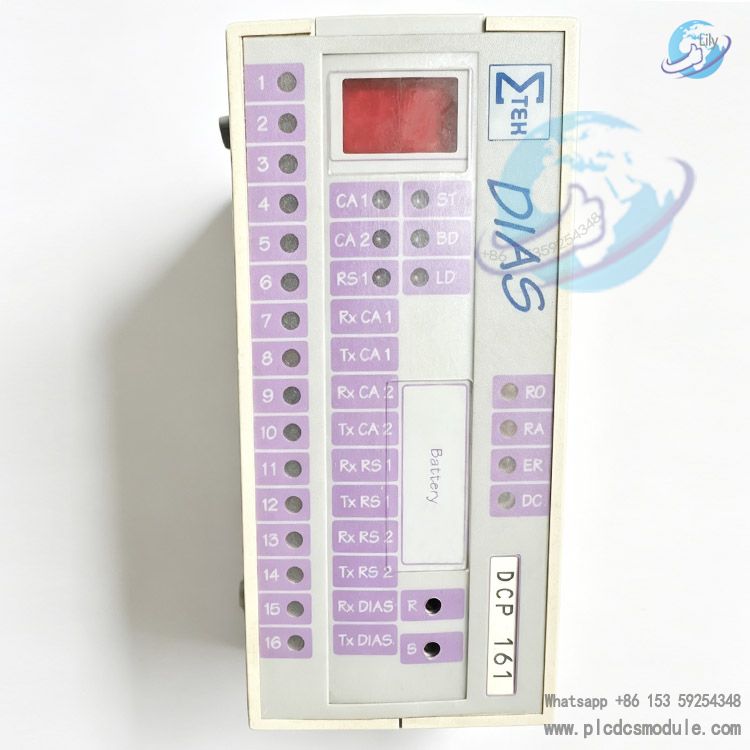
- Full-Channel Hardware LED Indicators: Independent LED lights for CPU operation status, bus transmit/receive, CAN parameter configuration, and fault alarms. On-site fault locating is available without professional programming software, greatly improving maintenance efficiency.
- Local Visualized Parameter Configuration: Built-in 2-digit 7-segment display with independent SET & RESET buttons. Users can modify CAN station ID and baud rate directly on the device without a PC, simplifying field commissioning operations.
- Standardized Fault Diagnosis System: 35 built-in fault codes displayed in "Er + Code" format, synchronizable with PG50 LASAL software. It accurately locates program overflow, bus disconnection, memory damage, and watchdog errors.
- Industrial-Grade Robust Design: Compliant with EN industrial EMC anti-interference standards, supporting a wide operating temperature range and shock-resistant structure, adapting to dusty, voltage-fluctuating harsh workshop environments.
Flexible Modular Expansion: Supports up to 16 DIAS I/O expansion modules, freely matching digital input, relay output, and analog acquisition modules to meet diverse on-site signal collection and control demands.
3. Complete Technical Specifications
3.1 Performance Specifications
3.1 Performance Specifications
3.2 Electrical Specifications
3.2 Electrical Specifications
3.3 Communication Interfaces
- CAN Bus: 1× channel, 9-pin D-SUB female socket
- RS1 Port: Fixed RS232 communication, 9-pin D-SUB male plug
- RS2 Port: Supports RS232/RS422/RS485, wired via DKL002 terminal base
3.4 Mechanical & Terminal Base Specifications
3.4 Mechanical & Terminal Base Specifications
3.5 Environmental Specifications
3.5 Environmental Specifications
4. Product Functional Features
4.1 Hardware Interaction Features
4.2 Program Storage & Operation Features
4.3 Compatibility Features
Fully compatible with all DIAS digital and analog I/O modules. Unique mechanical coding design prevents mis-insertion, effectively avoiding backplane damage caused by wrong module installation. The DKL002 base reserves dual +24V auxiliary power, CAN A/B differential signal lines, and common ground terminals, requiring no extra adapters for wiring.
5. Application Fields
- Plastic Molding Equipment: Vertical injection molding machines, mini blow molding machines. Matches temperature acquisition and proportional valve output modules to realize closed-loop temperature and pressure control.
- Standalone Packaging Machinery: Horizontal flow wrappers, mini sealing machines, label slitting machines. CAN bus connects conveying servos, and RS232 links HMI for quick parameter setup.
- Stamping & Hydraulic Machine Tools: Collects limit switch signals and controls cylinder action sequences, maintaining stable operation in strong electromagnetic interference workshop environments.
- Material Conveying & Sorting Equipment: Mini belt conveyors, simple sorting tables. Digital inputs collect photoelectric and proximity switch signals, and outputs control solenoid valves and sorting baffles.
- Woodworking Processing Machinery: Cutting machines, mini sanders. The built-in real-time clock accurately records machine running hours and fault logs.
- Legacy Automation Equipment Retrofit: Replaces outdated industrial mainboards, retains original I/O wiring to complete rapid electrical upgrades, and is compatible with traditional RS232 peripheral devices.
6. Matching Product Models
6.1 Mandatory DPS Power Modules
- DPS001 (05-002-001): Basic DIAS power supply, no fiber optic port
- DPS211 (05-002-211): Power module with 1 fiber optic output
- DPS221 (05-002-221): Power module with 2 fiber optic outputs
6.2 Complete DIAS Series Supporting Models
- Processor Modules: DCP161, DCP640, DCP642, DIP011
- Power Supply Modules: DPS001, DPS211, DPS221
- Terminal Base: DKL002 21-Pole Terminal Base
- I/O Modules: CDI161 16-Channel Digital Input, CTO163 16-Channel Relay Output, CAI042 Load Cell Analog Acquisition
- Auxiliary Accessories: CL090 Power Distribution Module, PL221 LED Pixel Control Module, 01-690-027 CR2450N Backup Lithium Battery
7. DIAS CPU Module Comparison
- DCP161: Entry-level economical CPU, INTEL386EX architecture, max 16 I/O modules, dual RS232 + single CAN bus. Optimized for standalone small machines, featuring low cost and simple commissioning for basic control scenarios.
- DCP640: Mid-range master controller, dual CAN bus support, expandable motion control modules for multi-axis linkage equipment, with richer hardware resources than DCP161.
- DCP642: High-end main controller, native fiber bus expansion, doubled computing cache capacity, suitable for multi-line production networking and complex multi-equipment linkage control.
- DIP011: Distributed remote slave processor, only used as field station controller, must network with DCP series master modules and cannot operate independently as a full-machine main control unit.
8. FAQ
- Q1: DC green LED stays off after power-onA1: The DC LED indicates normal +5V power supply; off status means power failure. Check DPS power module input, DIAS backplane connection and DKL002 base contact, and replace the DPS001 module for retesting if necessary.
- Q2: Display shows Er 08 fault codeA2: Er 08 refers to manual hardware reset trigger, causing controller operation suspension. Confirm no circuit short circuit, re-download the complete program, cut off and restart the main power to clear the error.
- Q3: Program lost after battery replacement with power cutA3: Power-off battery replacement will erase all SRAM-stored programs and variables. Re-upload the full control program via LASAL software; always replace the battery under power-on status in future operations.
- Q4: CAN bus frequent packet loss, TX/RX CAN LED abnormal flickerA4: 1. Short the terminal resistor jumper on DKL002 base at both ends of CAN bus; 2. Unify CAN node baud rate and station ID to avoid duplicate addresses; 3. Shorten wiring length and match standard baud rate distance.
- Q5: Maximum I/O modules supported by DCP161A5: Hardware limit is 16 DIAS I/O/P expansion modules. Exceeding the limit will trigger MAX.IO fault code and new modules will not be recognized.
- Q6: Can RS2 interface run RS485 directly without jumpers?A6: RS2 hardware supports RS485 protocol, but the DKL002 base has unassigned jumpers. An external signal conversion terminal is required, and differential communication cannot be switched directly.
- Q7: Status of RA yellow LED and RO green LEDA7: Steady RA yellow LED = Run programs in internal SRAM; Steady RO green LED = Run programs in external memory module.
- Q8: Er 04 CHKSUM error code troubleshootingA8: Causes include program checksum corruption, memory damage, and low battery data loss. Solutions: Replace backup lithium battery and re-download the control program; replace the DCP161 module if the error persists.