

Overview
The GE IS420UCSCH1B is a quad-core controller module from the GE Vernova Mark VIe control family. It belongs to the UCSC H1 (Universal Compact Controller, Hardware level 1) line and functions as both a high-performance control engine and a system gateway for Mark VIe and Mark VIeS turbine control platforms.
At its core sits an AMD G-Series quad-core processor running at 1.2 GHz, paired with 4 GB of DDR3 ECC SDRAM and a real-time, multi-tasking QNX Neutrino operating system. This deterministic compute core lets the controller execute complex speed/load regulation, protection logic and data-acquisition tasks in real time, without relying on a backplane or a hosted I/O rack.
The IS420UCSCH1B supports simplex, dual (DCC) and TMR (triple-modular redundant) architectures, making it a drop-in replacement and expansion unit for gas turbine, steam turbine, combined-cycle and petrochemical turbomachinery control systems.
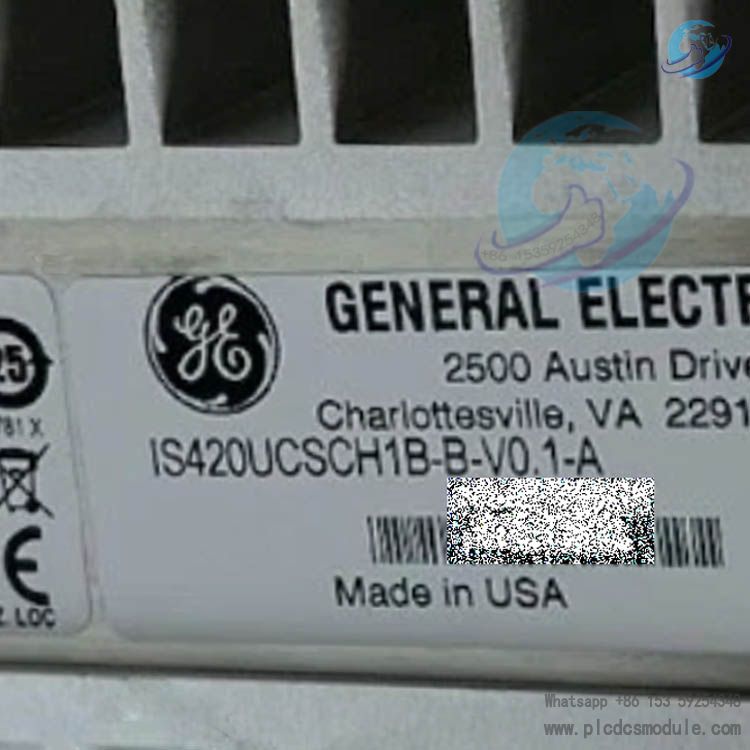
Model Code Breakdown
- IS420 — the GE Mark VIe module serial prefix; distinguishes Mark VIe-series hardware boards from earlier Mark V / Mark VI generations.
- UCSC — Universal Compact Controller; the compact, self-contained controller type in the Mark VIe portfolio.
- H1 — hardware level 1; denotes the AMD quad-core processor platform and its feature set.
- B — revision suffix; "B" marks the later revision of the H1 hardware level, carrying board-level improvements and firmware baseline updates.
Technical Specifications
| Parameter | Specification |
|---|---|
| Brand / Series | GE Vernova — Mark VIe / Mark VIeS |
| Module Type | UCSC H1 Quad-Core Controller / Gateway |
| Processor | AMD G-Series, quad-core, 1.2 GHz |
| Operating System | QNX Neutrino (real-time, multi-tasking) |
| Memory | 4 GB DDR3 SDRAM with ECC |
| Non-Volatile Storage | On-board solid-state flash for control programs, process variables and trend data |
| Redundancy Support | Simplex, dual (DCC) and TMR (triple-modular redundant) |
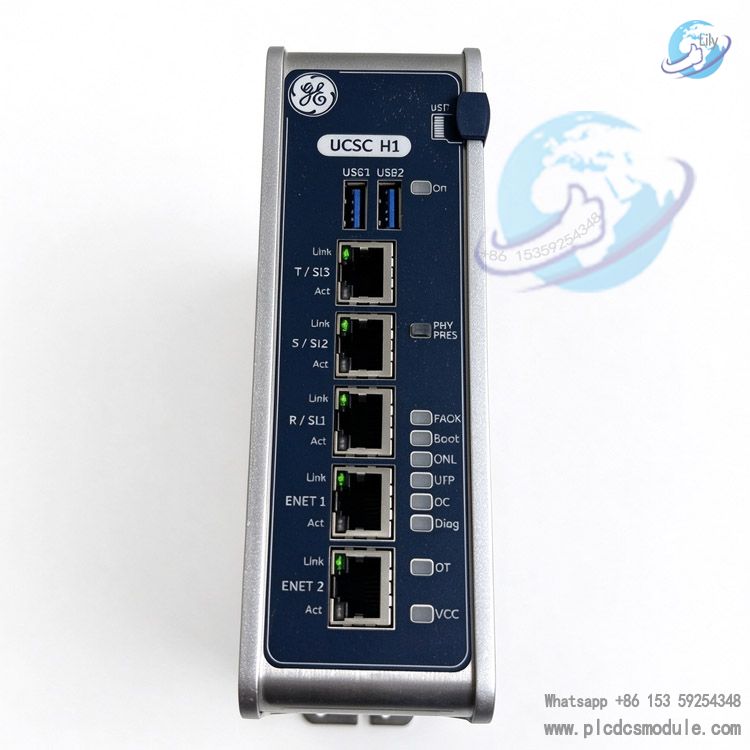
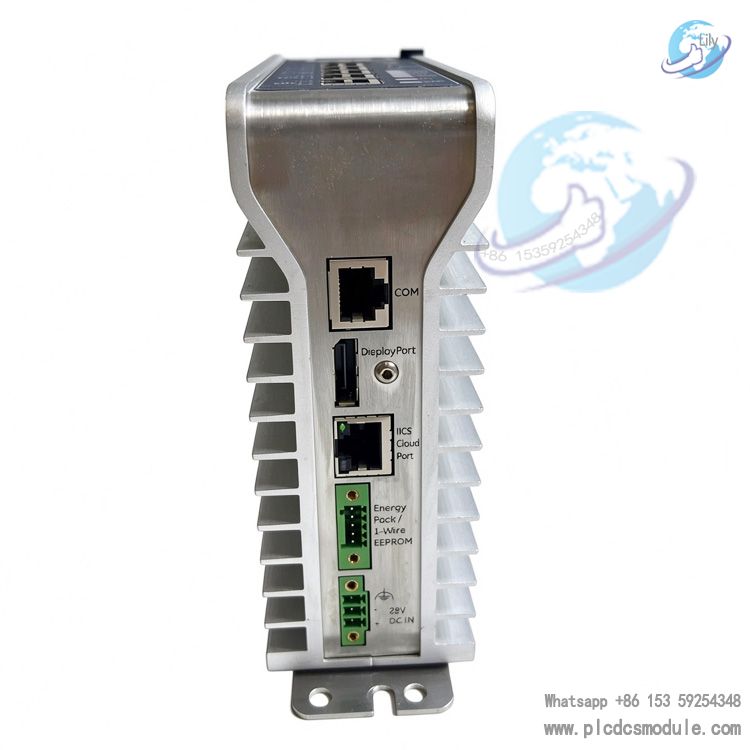
| Ethernet Ports | Multiple front-panel Ethernet ports (IONet redundant network + plant LAN), plus 1 bottom port |
| USB Interfaces | 2 × USB 2.0 |
| Communication Protocols | IONet, Modbus TCP, EGD (Ethernet Global Data), UDH, ToolboxST/ControlST configuration |
| Power Supply | 24 VDC (rated), wide-input DC support on series level |
| Operating Temperature | Wide industrial range (series rated down to approx. -30 °C; verify against GE manual for exact firmware version) |
| Mounting | Panel / rack installation, no backplane dependency |
| Certifications (series) | Industrial ATEX / CSA / UL class certificates for hazardous-area deployment |
Key Advantages
- Deterministic real-time control — QNX Neutrino plus a quad-core AMD processor delivers predictable loop timing for speed and load regulation.
- ECC memory integrity — 4 GB DDR3 with ECC corrects single-bit errors and reduces the risk of memory corruption under industrial EMI.
- Flexible redundancy — one module works in simplex, dual or TMR configurations; redundant deployment enables bumpless, no-single-point-of-failure handover.
- Independent operation — no backplane and no hosted I/O rack dependency simplifies cabinet layout and on-site commissioning.
- Open & plant-wide integration — native IONet plus Modbus TCP, EGD and UDH bridges turbine control, auxiliary DCS and excitation systems.
Remote, encrypted firmware updates — ToolboxST supports secure batch updates without on-site disassembly.
Applications
- Gas turbine and steam turbine real-time control, speed regulation and unit protection logic.
- Mark VIeS safety control loops and safety-instrumented-system (SIS) integration.
- DEH (digital electro-hydraulic) governing and ETS (emergency trip system) control in fossil-fired power plants.
- Combined-cycle, heat-recovery and captive-power-plant turbine main-control upgrades.
- Petrochemical turbomachinery drive control and safety interlock systems.
- Balance-of-plant (BoP) auxiliary DCS, static excitation (EX2100e) and small-hydro governing.
Working Principle
The IS420UCSCH1B runs a QNX Neutrino real-time multitasking kernel on an AMD G-Series quad-core processor. Its control application is configured with GE ToolboxST / ControlST, using function block diagrams (FBD), relay ladder diagrams (RLD) and sequential function charts (SFC).
Because the module hosts no field I/O of its own, it gathers process measurements from external Mark VIe I/O modules over the redundant IONet industrial Ethernet, executes closed-loop control and protection algorithms, then issues commands back through IONet to the field devices. In redundant pairs or TMR triplets, multiple controllers run the same logic and vote / hand over seamlessly, eliminating single-point input loss and unplanned trips. Firmware and configuration are versioned and updated remotely in encrypted form via ToolboxST.
In-Series Comparison
| Model | Core / Platform | Typical Role |
|---|---|---|
| IS420UCSCH1A | AMD quad-core (H1) | UCSC H1 quad-core controller, base revision |
| IS420UCSCH1B | AMD quad-core (H1) | UCSC H1 quad-core controller, "B" revision — this product |
| IS420UCSCH2A | AMD dual-core | Lighter-duty UCSC controller for smaller applications |
| IS420UCSCS2 / UCSA | Dual-core safety platform | Mark VIeS safety controllers for SIL 2/3 loops |
| IS420UCSEH2A (newer) | Intel i7 quad-core + PROFINET | Newer UCSE generation, native PROFINET and 8 Ethernet ports |
Where a dual-core UCSC is enough for light auxiliary loops, the quad-core IS420UCSCH1B suits heavier, mixed regulation + gateway duties. For newer installations GE positions the UCSE series as the evolution path, yet the UCSC H1 remains widely stocked and supported for in-service Mark VIe fleets.
Companion Products
- Mark VIe I/O modules — analog/digital I/O cards connected over IONet.
- Mark VIe power supply modules — 24 VDC input / bus power for the controller chain.
- Mark VIeS safety I/O and safety controllers for SIL-rated loops.
- EX2100e static excitation units for generator excitation integration.
- IONet switches and ToolboxST / ControlST software suites for configuration and diagnostics.
Supply Advantages
- New and tested surplus stock of the IS420UCSCH1B for urgent turbine-control spares.
- Straight drop-in compatibility with existing Mark VIe UCSC H1 installations.
- Guaranteed specification against the GE manual — no silent substitutions.
- Global logistics covering power, petrochemical and semiconductor plants.
Frequently Asked Questions
A: It is the GE Mark VIe UCSC H1 quad-core controller / gateway used for turbine control, plant auxiliary DCS and safety-system integration in gas, steam and combined-cycle plants.
A: Yes. The module serves Mark VIe and Mark VIeS platforms as a control and gateway unit; safety SIL loops use the dedicated UCSCS safety controllers alongside it.
A: An AMD G-Series quad-core processor at 1.2 GHz, running a QNX Neutrino real-time multi-tasking OS.
A: Yes — simplex, dual (DCC) and TMR triple-modular redundant architectures are supported, enabling seamless, no-single-point-of-failure handover.
A: In redundant pairs one unit can be swapped while the other keeps running; GE recommends a planned outage to avoid unintended unit trips.
A: GE ToolboxST / ControlST, supporting FBD, RLD and SFC programming; firmware can be updated remotely and in encrypted form.
A: IONet, Modbus TCP, EGD (Ethernet Global Data) and UDH, alongside the ToolboxST configuration channel.
A: No. All process signals reach external Mark VIe I/O modules via the redundant IONet network, so the controller stays independent of a backplane or hosted I/O rack.