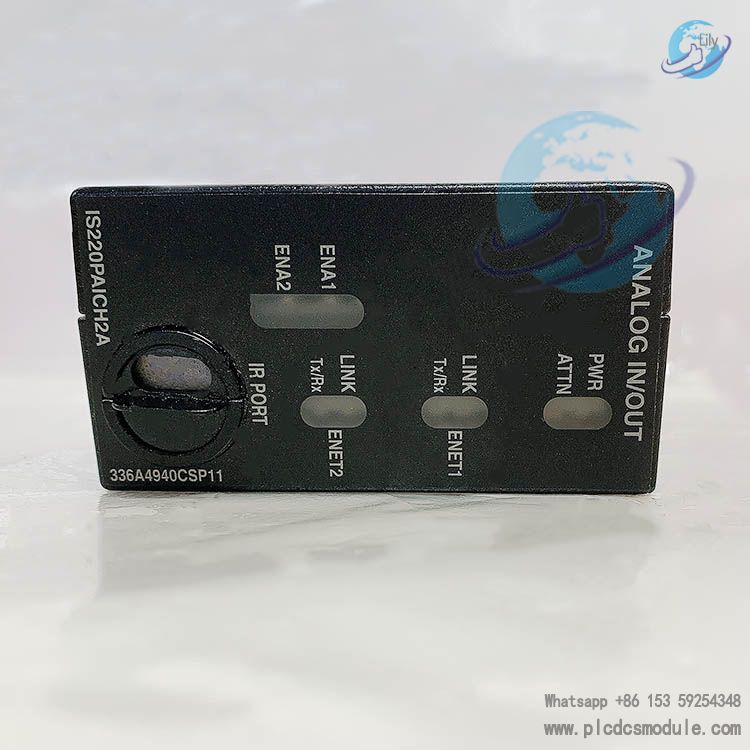


GE IS420YAICS1B ANALOG IN/OUT PACK Module
The GE IS420YAICS1B is an analog I/O Pack for the Mark VIe / Mark VIeS safety turbine‑control system. Certified for SIL‑3 safety level, it integrates both analog input and analog output functions. It acquires 4‑20 mA / voltage sensor signals such as temperature, pressure and vibration, and outputs regulating signals to valve actuators. It serves as a core module for closed‑loop regulation and safety monitoring of gas turbines and steam turbines.
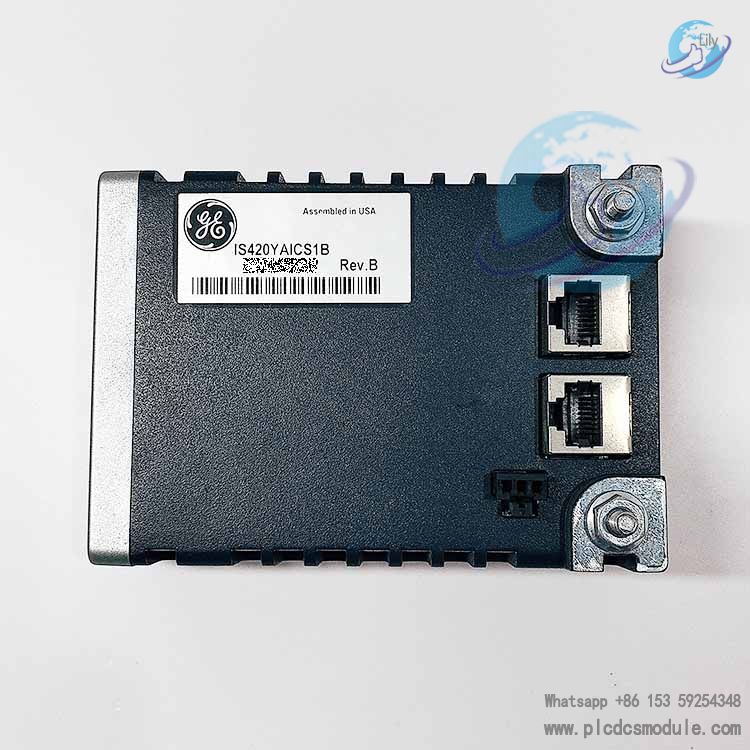
Specifications
- Brand:GE Vernova
- Model:IS420YAICS1B
- Type:Analog In/Out I/O Pack
- Compatible system:Mark VIe, Mark VIeS
- Safety Level:SIL3 (TÜV certified)
- Channel:10 AI + 2 AO
- AI 1–8:±5V, ±10V, 4–20mA
- AI 9–10:±1mA, 4–20mA
- Resolution:16‑bit ADC
- Communication:Dual RJ45 IONet Ethernet
- Power supply:24VDC
- Operating temperature:‑40℃ ~ +70℃
- Origin:USA
- Product Status:Discontinued,Only spare‑parts stock available
- Certification:CE, SIL3
FAQ
Q1:Can IS420YAICS1B be directly connected to field sensors?
A1:No. It must be used with matching terminal boards: IS410STAIS2A (Simplex) or IS410TBAIS1C (TMR). The I/O Pack itself has no field‑wiring terminals.
Q2:Does it support TMR triple‑modular redundancy?
A2:Yes. One module is used for Simplex configuration; three identical modules are required for TMR architecture. Hardware revisions must match; mixing Revision‑A and Revision‑B units is not permitted.
Q3:What are AO channels used for?
A3:The 2 analog‑output channels drive regulating valves and electro‑hydraulic actuators to realize continuous modulation control for fuel valves and inlet guide vanes.
Q4:What are the accuracy specifications?
A4:Full‑scale accuracy ±0.1 % FS, suitable for high‑precision unit control and protection loops.
Q5:Is its network compatible with safety DI/DO modules?
A5:Yes. It uses the dual‑port IONet Ethernet in common with IS420YDIAS1B and IS420YDOAS1B, sharing the Mark VIeS IONet network.
Q6:Does it come with built‑in channel diagnostics?
A6:Yes. It provides open‑circuit, short‑circuit and over‑range diagnostics. On‑board LEDs indicate channel‑level and module‑level faults.
Q7:How does it differ from non‑SIL analog modules?
A7:It holds SIL‑3 safety certification with safety‑loop diagnostics and voting capability, and can be applied to SIF (Safety Instrumented Function) loops. Conventional PAIC analog modules do not meet SIL safety requirements.
Q8:What are the typical application scenarios?
A8:Gas turbines, steam turbines and combined‑cycle power units; acquisition of pressure, temperature and displacement sensor signals; closed‑loop regulation for speed‑governing valves and fuel valves.