

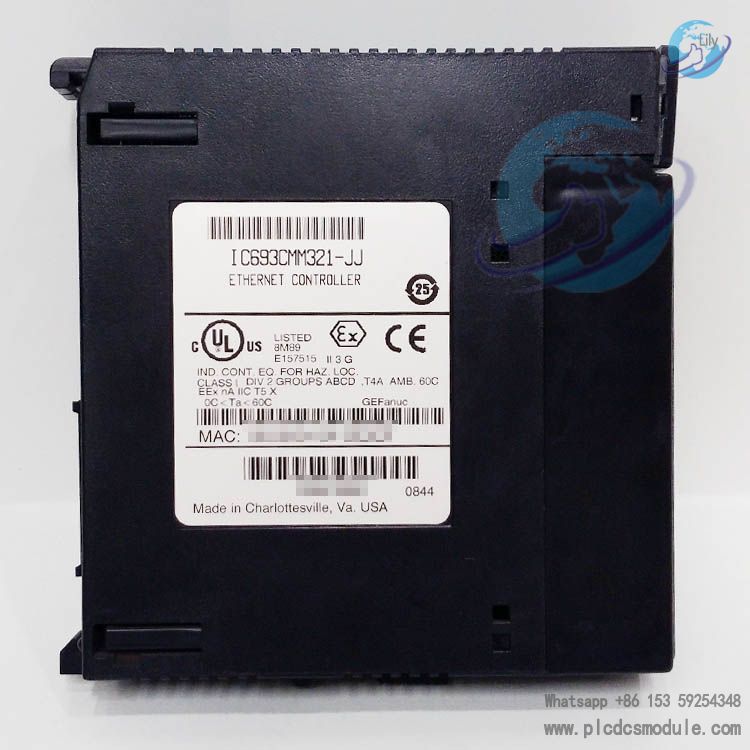
The GE IC693CMM321 Ethernet Interface Module is a core communication component tailor-made for the Series 90-30 PLC. It establishes a stable connection between the PLC and an Ethernet LAN via external transceivers and AAUI cables, building a communication bridge between the PLC and the hosts as well as other control devices on the network.
Boasting dual client and server capabilities, this module supports diverse functions such as simultaneous multi-device communication and cross-vendor device compatibility. Equipped with comprehensive hardware interfaces and diagnostic mechanisms, it provides reliable support for network integration, data transmission, and maintenance management of industrial automation systems. It serves as a critical hardware solution for integrating the Series 90-30 PLC into Ethernet environments.
related documents

Functional Features
Two-Way Communication & Network AccessAs a client, it can actively initiate communication with other Ethernet-enabled PLCs via the COMMREQ function block in ladder logic programs. As a server, it only responds to requests from hosts (running host communication toolkit applications) or other Series 90-30 PLCs operating in client mode, enabling bidirectional data exchange. It supports direct connection of the PLC to Ethernet networks, while also allowing data transmission requests to be initiated to the PLC from other devices.

Hardware Structure and Interface Description
Panel Component Layout
The top of the module is equipped with 4 LED indicators, with a reset button directly beneath them. The panel features multiple dedicated ports, including the Station Manager port, Firmware Upgrade port (Downloader port) and Transceiver port (AAUI port). A label showing the default MAC address and serial number is affixed to the exterior of the plastic housing. The overall layout is clear, facilitating operation and identification.
Key Hardware DetailsLED IndicatorsThe module is fitted with four indicators: OK, LAN, SER and STAT. These indicators display four working states (steady on, off, slow flashing, fast flashing), providing intuitive feedback on interface operating status, communication traffic of the transceiver port and download port, as well as the occurrence of abnormal events. They serve as a visual basis for troubleshooting.Reset ButtonThis button has four core functions: LED test, normal reset, reset with reload, and reset with maintenance tool activation. Note: The button cannot be operated when the front cover of the module is closed, ensuring operational safety.
Serial Ports
Station Manager Port: It adopts the RS-232 protocol and is equipped with a 6-pin RJ-11 connector. It is used to connect a terminal or terminal emulator for accessing the Station Manager software built into the module. The IC693CBL316 station management cable is recommended for connection (refer to Chapter 10 for detailed parameters).
Firmware Upgrade Port (Downloader Port): It complies with the RS-485 protocol and comes with a 15-pin D-sub connector. It is designed for connecting to a PC downloader when the module communication software requires an update. Connection requires the IC690ACC901 compact converter/cable kit (refer to Appendix E for detailed parameters).
AAUI (Transceiver) Port: This 14-pin AAUI interface connects to an external Ethernet-compatible transceiver via an IEEE 802.3 transceiver cable. GE Fanuc transceivers IC649AEA102 (for 10Base-T) or IC649AEA103 (for 10Base2) are recommended, and equivalent compatible products are also acceptable (refer to Appendix J for detailed parameters).
Customers who purchased this product are also browsing the following products:
GE/VMIC VMIVME-7750-466000 VMEBus SBC Processor
GE IS220PVIBH1A MARK VIE Vibration I/O Pack BPPB
GE EPSCPE100-ABAC Standalone Controller
GE IS200TRLYH1BGF Mark VI Relay Output Board