

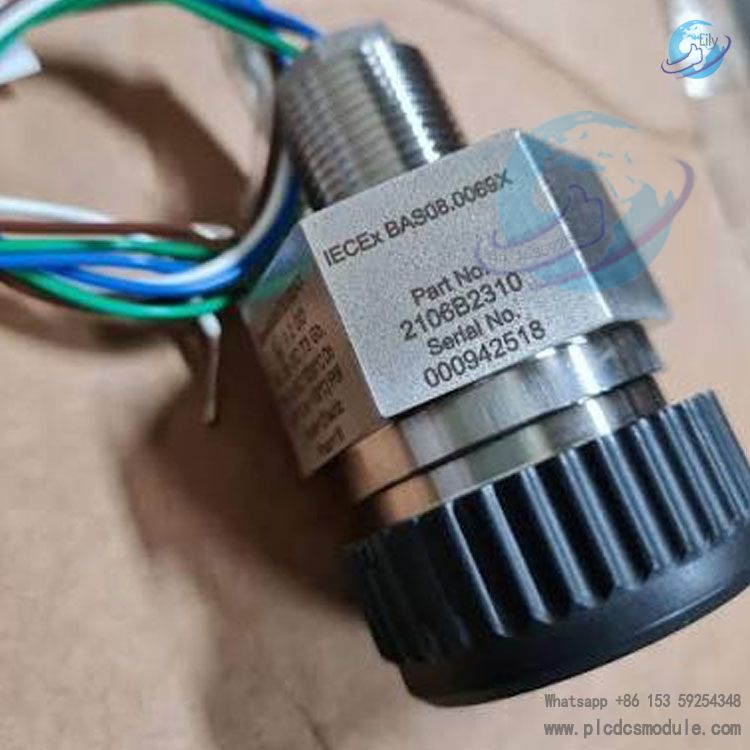
HONEYWELL 2106B2310 Combustible probe sensor
Overview
HONEYWELL 2106B2310 belongs to the Sensepoint HT series high‑temperature combustible gas probe. It adopts catalytic bead detection principle with hardware optimizations for high‑temperature hazardous areas. The 2106B2310 outputs mV bridge signal, and its measuring range can be switched from 0‑20% LEL to 0‑100% LEL depending on the matched control board, suitable for detecting multiple combustible gases such as methane, propane and hydrogen. Equipped with Sieger anti‑poisoning sensing element, the 2106B2310 resists interference from sulfides and other on‑site media and maintains stable baseline within ‑55℃~+150℃ operating conditions. Its minimum alarm threshold can be set at 5% LEL, widely applied for leak monitoring in industrial high‑temperature enclosed spaces. Constructed with 316 stainless steel housing and ATEX explosion‑proof certification, the unit supports long‑term continuous operation in high‑risk sites such as chemical plants and power generation facilities.
Technical Specifications
| Detection Principle | Catalytic bead type |
| Output Signal | mV bridge signal |
| Measuring Range | 0‑20% LEL, 0‑100% LEL (determined by matched control board) |
| Response Time | T60<6 s, T90<10 s |
| Minimum Alarm Set‑point | 5% LEL |
| Operating Temperature | ‑55℃ ~ +150℃ |
| Operating Humidity | Continuous 20‑90% RH; Intermittent 10‑99% RH |
| Operating Pressure | 75‑110kPa |
| Power Consumption | 0.7W, operating current 200mA |
| Housing Material | 316 stainless steel |
| Thread Interface | M20 |
| Certification | ATEX hazardous area certification |
| Ingress Protection | IP65/IP67 |
| Shipping Weight | Approx. 1.5kg |
Core Advantages
- Excellent wide high‑temperature resistance. The 2106B2310 can run stably at 150℃ for long‑term operation, solving high‑temperature drift and failure issues of ordinary combustible sensors, ideal for high‑temperature measuring points such as ovens and turbine casings.
- Outstanding anti‑poisoning performance. Sieger matched sensing unit reduces sensor poisoning and failure caused by hydrogen sulfide and silicone substances, lowering frequent on‑site calibration and replacement frequency.
- Fast signal response. Quick concentration feedback upon gas exposure to shorten leak alarm delay time.
- Corrosion‑resistant stainless steel housing, suitable for industrial sites with humid and corrosive vapors.
- Intrinsically‑safe front‑end design supports sensor replacement under powered condition; no full‑system power‑off shutdown required for on‑site maintenance.
Product Features
- 2106B2310 is a Sensepoint HT high‑temperature combustible probe. Gas concentration conversion and output are realized via Wheatstone bridge. It has no built‑in display or alarm functions and shall connect to external controller to collect mV bridge signal.
- Equipped with M20 thread interface, the probe can be directly mounted to explosion‑proof junction box for on‑site wiring.
- Superior baseline stability with low zero drift across wide temperature range, enabling low‑threshold alarm configuration.
- Sintered filter is not required to accelerate gas permeation and improve response efficiency.
- Fully compliant with ATEX explosion‑proof specifications for installation in explosive gas hazardous areas.
- Modular sensor unit; sensing component can be replaced individually upon fault to cut operation & maintenance cost.
Application Fields
- Combustible gas leak monitoring inside gas turbine compartments
- High‑temperature drying furnaces for solvent printing and coating processes
- High‑temperature process compartments in petrochemical industry
- High‑temperature equipment protection zones in power plants
- Enclosed high‑temperature chambers in heat‑treatment workshops
- High‑temperature hazard monitoring points for oil & gas exploitation
- Gas safety protection for factory high‑temperature explosion‑proof workshops
- Safety monitoring for high‑temperature enclosed cavities of energy equipment
Product Comparison
| Item | 2106B2310 | 2106B2311 | 2106B1402 |
|---|---|---|---|
| Product Positioning | High‑temperature combustible probe Sensepoint HT | Normal‑temperature combustible probe Sensepoint | Toxic hydrogen sulfide sensor |
| Operating Temperature | ‑55~+150℃ | ‑40~+80℃ | ‑25~+50℃ |
| Measured Media | Multiple combustible gases LEL | Multiple combustible gases LEL | Hydrogen sulfide H₂S |
| Signal Output | mV bridge signal | mV bridge signal | 4‑20mA loop |
| Applicable Scenarios | High‑temperature hazardous areas | Normal‑temperature explosion‑proof areas | Toxic gas detection points |
Matching Accessory Models
- Sensepoint XCD Gas Controller
- 2106B0001 Explosion‑proof Junction Box
- SP‑WPC Weather Protection Cap
- SP‑DK Duct Mounting Kit
- SP‑FA Flow Adaptor Fitting
- SP‑CC Gas Collecting Cone Accessory
Recommended HONEYWELL Models
- 2106B2311, Sensepoint Flammable Sensor
- 2106B2312, Sensepoint HT Flammable Sensor
- 2106B1402, Sensepoint H2S Toxic Sensor
- 2106B1502, Sensepoint CO Toxic Sensor
- 2106B1602, Sensepoint O2 Sensor
- 2106B1702, Sensepoint NH3 Toxic Sensor
- 2106B1802, Sensepoint SO2 Toxic Sensor
- 2106B1902, Sensepoint Cl2 Toxic Sensor
- 2106B2002, Sensepoint NO2 Toxic Sensor
- 2106B0001, Sensepoint Exd Junction Box
- SPXCDULNFX, Sensepoint XCD Controller
- 2110B2001, Sensepoint Remote Sensor
- 2106B2102, Sensepoint H2 Toxic Sensor
- 2106B2202, Sensepoint NO Toxic Sensor
- SP‑DK, Duct Mounting Kit
FAQ
Q: Can 2106B2310 work standalone without external controller?
A: No. The 2106B2310 only outputs raw mV bridge signal without display or alarm logic. It must work with Sensepoint series controller or DCS system supporting mV bridge signal acquisition.
Q: 2106B2310 maximum long‑term operating temperature is 150℃, is transient over‑temperature acceptable?
A: Long‑term operation above 150℃ is not recommended. Short‑term peak over‑temperature will accelerate catalytic bead aging and shorten sensor service life. Sustained over‑temperature results in zero drift and inaccurate detection.
Q: What is typical lead‑time for 2106B2310 purchase? Is small‑order available?
A: Stock items have short lead‑time. Lead‑time for out‑of‑stock units is subject to supply‑chain fluctuation. Single‑unit order is supported. Confirm lead‑time in advance for bulk orders.
Q: What gases can 2106B2310 detect? Can it measure VOC volatile organic gases?
A: It is designed for combustible hydrocarbon gases including methane, propane, butane and hydrogen. Catalytic bead principle is not suitable for direct VOC measurement. High‑concentration silicone vapors may cause irreversible poisoning damage to sensing element.
Q: How to select between 2106B2310 and 2106B2311? Are they directly interchangeable?
A: 2106B2310 is high‑temperature version while 2106B2311 is normal‑temperature version. They share identical interface and electrical signal and are hardware interchangeable. However 2106B2311 cannot be deployed above 80℃; 2106B2310 shall be selected for high‑temperature working conditions.
Q: What is recommended calibration interval and typical service life for 2106B2310?
A: Calibration every 6‑12 months is suggested for regular industrial sites. Shelf life is up to 5 years under sealed storage. Actual field service life depends on media, temperature and contamination level; 3‑5 years is common for most working conditions.
Q: What explosion‑proof requirements shall be met for junction box during 2106B2310 installation?
A: The probe itself carries ATEX certification. Matched junction box shall have Exd explosion‑proof certification with M20 thread matching. Wiring in hazardous areas shall strictly follow explosion‑proof construction specifications.
Q: What are major causes for severe zero drift on 2106B2310?
A: Main causes include long‑term high‑temperature overload, poisoning by sulfide / silicone media, condensation water ingress under high humidity, mechanical vibration damage to catalytic bead. Perform calibration first when drift occurs. Replace sensing component if calibration fails.
Precautions
- 2106B2310 is catalytic bead sensing probe. Avoid exposure to silicone grease, silicone vapors and high‑concentration hydrogen sulfide; such substances will lead to irreversible poisoning and failure of sensing element.
- Do not deploy in environment with oxygen enrichment over 25% VOL. Oxygen‑rich atmosphere alters combustion reaction characteristics and causes detection deviation.
- Avoid installation positions under direct water spray or strong direct air flow. Equip weather protection cap to improve reliability for outdoor applications.
- Refer to official datasheet parameters for each maintenance and calibration operation. Do not modify alarm thresholds arbitrarily.
- Do not over‑torque sensor head during mechanical installation to prevent physical damage to internal catalytic bead.
- Do not operate continuously above 150℃. Confirm actual maximum process temperature on‑site before model selection.
Product Tags
HONEYWELL 2106B2310,2106B2310,Sensepoint HT,Combustible probe sensor,flammable gas sensor, High‑temperature combustible gas probe, catalytic bead gas sensor, industrial hazardous area gas detection,ATEX gas sensor,M20 gas probe,316 stainless steel gas sensor